

Article
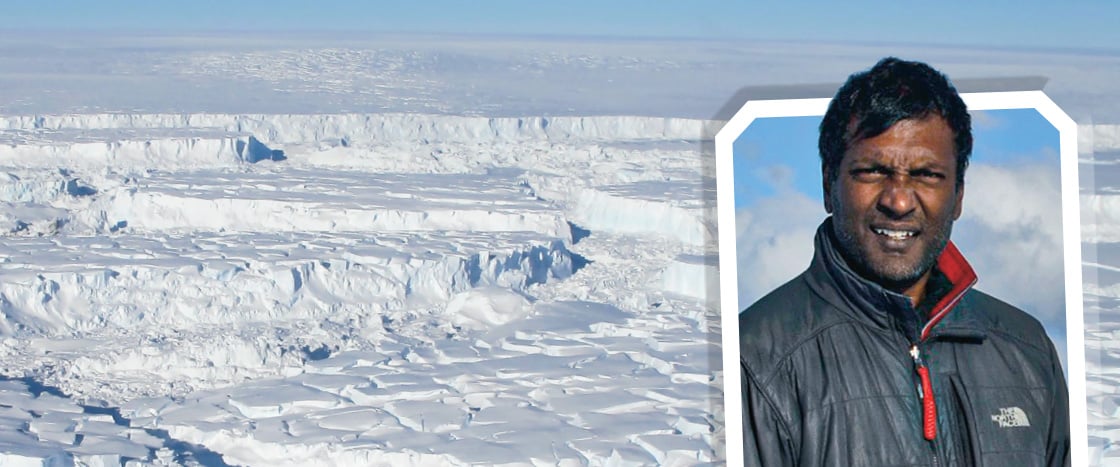
James Yungel/NASA (Glacier); Courtesy of Sridhar Anandakrishnan

I Investigate Glaciers

Sridhar Anandakrishnan studies glaciers in a rapidly changing Antarctica.

By Amy Barth and Alice Sun
From the February 2026 Issue

Learning Objective: Students will summarize how and why a glaciologist studies changing glaciers.

Lexile: 860L; 610L
Other Focus Areas: Weather & Climate, Human Impacts

Standards

Download and Print

Jim McMahon/Mapman ®

A small, but special, plane flies over Antarctica. With skis instead of wheels, it lands on a glacier. Soon it takes off, leaving Sridhar Anandakrishnan and his team of scientists alone on the remote ice sheet. They stand on Thwaites (thwayts), the continent’s largest glacier. The team will live and work here for the next three months!

Anandakrishnan is a glaciologist (glay-shee-AH-luh-jist) at Pennsylvania State University. He studies giant ice masses like Thwaites. But this work might not be possible for much longer. For the past several decades, Earth’s temperature has been getting hotter and weather patterns have been shifting. These changes are causing glaciers to melt. So Anandakrishnan is working to understand how quickly glaciers around the world are disappearing. 

A small plane flies over Antarctica. It’s special because it has skis instead of wheels! The plane lands on a glacier. Sridhar Anandakrishnan and his team of scientists get off. The plane flies away. The scientists are left alone on Thwaites (thwayts). It’s the continent’s largest glacier. The team will live and work on the ice sheet for the next three months!

Anandakrishnan is a glaciologist (glay-shee-AH-luh-jist). He works at Pennsylvania State University. He studies giant ice masses like Thwaites. But maybe not for much longer. Earth’s temperature has been warming for the past several decades. And weather patterns have been shifting. These changes are causing glaciers to melt. Anandakrishnan wants to learn how quickly glaciers around the world are disappearing.

Courtesy of Sridhar Anandakrishnan 

Anandakrishnan braces against strong Antarctic winds.

To study glaciers, he must travel to cold, remote places. In fact, he’s been on research trips to Antarctica more than 20 times! There’s no way to get supplies, so the team must bring everything it needs. 

“We cook our own food, melt snow to make water, and fix our snowmobiles if they break,” says Anandakrishnan. He spoke to Scholastic about studying glaciers and what he’s learning about Antarctica’s quickly changing environment.

He must travel to cold and remote places to study glaciers. In fact, he’s been on research trips to Antarctica more than 20 times! There’s no way to get supplies. So the team must bring everything it needs.

“We cook our own food, melt snow to make water, and fix our snowmobiles if they break,” says Anandakrishnan. He spoke to Scholastic about studying glaciers. He shared what he’s learning about Antarctica’s quickly changing environment.

How did you become interested in glaciers?

When I was an engineering student at the University of Wisconsin, I had a job fixing research equipment that was being sent to Antarctica. Later I was asked to go to Antarctica to install the equipment. It sounded like a fun adventure, so I went. I became so excited about the place and the science that I changed my area of study so I could study glaciers.

I was an engineering student at the University of Wisconsin. I had a job fixing research equipment being sent to Antarctica. Later I was asked to go to Antarctica to install the equipment. It sounded like a fun adventure. So I went. I got excited about the place and the science. I changed my area of study to study glaciers.

Why is it important to study glaciers in Antarctica?

Antarctica has thousands of glaciers that are melting into the ocean. Over the past 200 years, humans’ widespread burning of fossil fuels has released greenhouse gases into the atmosphere. The gases trap heat. Before this happened, the amount of water leaving a glacier was about the same as the amount of snow that falls on it. Now the warming climate is causing temperatures in Antarctica to rise. Glaciers are melting faster than their ice is being replaced. The extra melted water makes the sea level rise. Rising seas flood coastal areas. By learning more about glaciers, we can prepare for the future.

Antarctica has thousands of glaciers melting into the ocean. Humans have been burning fossil fuels for the past 200 years. That’s released greenhouse gases into the atmosphere. The gases trap heat. In the past, some water would melt from a glacier. The amount was about the same as the snow that fell on the glacier. Now the warming climate is causing Antarctica to get hotter. Glaciers are melting faster than their ice is being replaced. The extra melted water makes the sea level rise. Rising seas flood coastal areas. We need to learn more about glaciers. It can help us prepare for the future.

Courtesy of Sridhar Anandakrishnan 

A special plane transports the team and its gear to Antarctica.

Why study Thwaites in particular?

Thwaites is one of the largest glaciers in the world—about the size of Florida. It’s home to an enormous amount of ice. At the end of the glacier, floating sheets of ice called ice shelves help block Thwaites from tumbling into the sea. But warming temperatures are melting the ice shelf. This means the glacier is flowing into the ocean more quickly. 

Over the next 100 years, melted ice water from Thwaites could raise the sea level by as much as 2 feet (61 centimeters). Nearly 150 scientists are building a computer model to help predict what will happen to Thwaites. To make an accurate model, we need to know the size of the glacier and how fast it’s flowing. I’ve been gathering data on the glacier’s thickness. I do this by sending radio and sound waves through the ice. Changes in the shape of the waves tell us about the glacier’s depth and how it’s changing.

Thwaites is one of the largest glaciers in the world. It’s about the size of Florida. It’s home to a huge amount of ice. There are floating sheets of ice at the end of the glacier. These ice shelves keep Thwaites from falling into the sea. But the ice shelves are now melting. This means the glacier is flowing into the ocean faster.

Melted ice water from Thwaites is raising sea levels. It could cause them to go up by as much as 2 feet (61 centimeters). That’s over the next 100 years. Nearly 150 scientists are building a computer model. It can help predict what will happen to Thwaites. The model needs to be accurate. We need to know the size of the glacier. And we need to know how fast it’s flowing. I’ve been gathering data on the glacier’s thickness. I send radio and sound waves through the ice. Changes in the shape of the waves tell us about the glacier’s depth.

What do you hope to discover?

Hopefully, we’ll learn what’s likely to happen to the glacier in the future. Then we can predict how much the sea level will rise if Earth keeps warming at its current rate. I hope we can gather enough evidence to influence world leaders to limit the amount of carbon dioxide we release into the atmosphere. This greenhouse gas is one of the major causes of climate change.

Hopefully, we’ll learn what might happen to the glacier in the future. Then we can predict how sea levels will rise. That’s if Earth keeps warming at its current rate. I hope we can gather enough evidence for world leaders. It may persuade them to limit the amount of carbon dioxide we release. This greenhouse gas is one of the major causes of climate change.

What’s your advice for kids interested in a career like yours?

Math and physics are central to the work I do, so it’s important to study those areas. I think our field needs people from all kinds of backgrounds. I’m a city kid and a person of color. If you can picture yourself doing this type of work—regardless of where you come from—you can make it happen!

Math and physics are central to the work I do. So it’s important to study those areas. I think our field needs people from all backgrounds. I’m a city kid and a person of color. It doesn’t matter where you come from. If you can picture yourself doing this type of work, then you can make it happen!

Ice Core Project
Watch a video about collecting ice samples from glaciers.
video (1)
Activities (3)
Answer Key (1)
Text-to-Speech