


Article
All Canada Photos/Alamy Stock Photo

Groundhogs Get Their Day

What’s the real story behind the groundhogs that “predict” winter’s end?

By Katie Free, Illustrated by Andy Elkerton
From the February 2026 Issue

Learning Objective: Students will use text evidence to explain how groundhogs affect their ecosystem.

Lexile: 880L; 630L
Othe Focus Areas: Math

Standards

Download and Print
Ecosystems
Watch a video to learn more about ecosystems and food chains.

Every February 2, tens of thousands of people trek through the early morning cold to a place called Gobbler’s Knob. They’ve come to this hill near Punxsutawney, Pennsylvania, to watch a groundhog named Phil predict the weather.

A group of men in top hats gathers around a fake tree trunk with a tiny door. One knocks. Punxsutawney “Punxsy” Phil crawls out, looking left and right for his shadow. According to tradition, if he sees it, winter weather will last another six weeks. If not, an early spring will come. 

This is Phil’s big moment. But what do these critters do during the rest of the year? And what are they like in the wild?

Thousands of people walk to a place called Gobbler’s Knob every February 2. This hill is near Punxsutawney, Pennsylvania. The crowd has come even though it’s early and cold. They’re here to see a groundhog named Phil predict the weather!

A group of men in top hats gathers around a fake tree trunk with a tiny door. One knocks. Punxsutawney “Punxsy” Phil crawls out. He looks left and right for his shadow. There’s a tradition about whether he sees it. Winter weather will last another six weeks if he does. An early spring will come if he doesn’t.

This is Phil’s big moment. But what do groundhogs do the rest of the year? And what are they like in the wild?

Illustrated by Andy Elkerton

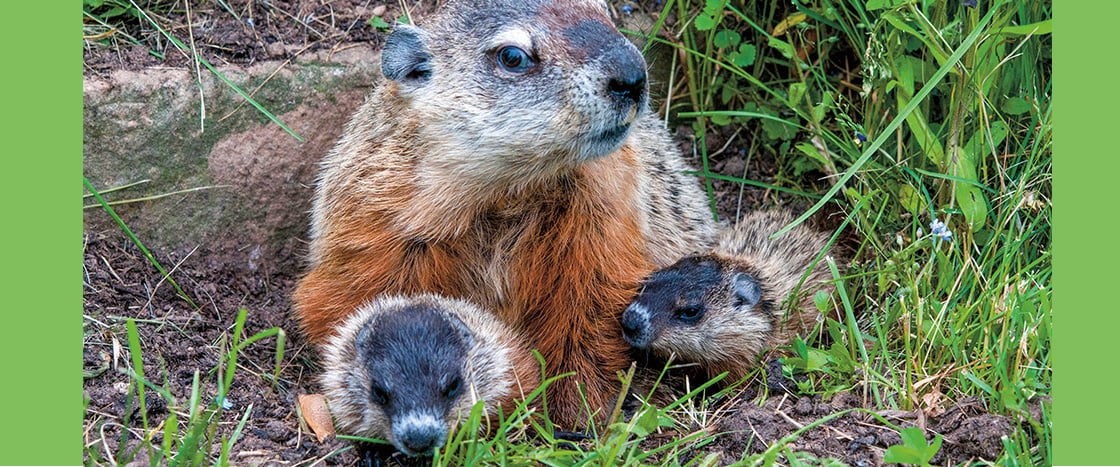
Groundhog babies are born in the spring. Mothers raise the pups in a burrow. 

A Day in the Life

Groundhogs—also called woodchucks and whistle pigs—are closely related to squirrels. The cat-size mammals weigh about 9 pounds (4 kilograms). They have thick claws and powerful legs. They’re found throughout much of the eastern U.S. and Canada, where they dig underground homes called burrows.

Groundhogs follow a similar schedule every year. When winter begins, they crawl into their burrows to hibernate. Their heart rates drop, their breathing slows, and their body temperatures can sink as low as 37°F (3°C). That’s only a few degrees above freezing! They stay in this sleeplike state until warmer spring weather arrives.

In the summer, hungry groundhogs focus on one thing: eating! These critters need to double their weight to survive their winter hibernation. They feast on plants like dandelions, along with whatever fruits and vegetables they can find.

Home gardens are especially enticing. “It’s like putting a dessert tray in front of a toddler and saying, ‘Don’t eat it,’” says Chris Maher. She’s a biologist at the University of Southern Maine who has studied groundhogs for 28 years. Being expert diggers and climbers, groundhogs can easily get past farmers’ fences. They’re often considered pests. But they play an important role in their ecosystem.

Groundhogs are also called woodchucks and whistle pigs. They’re closely related to squirrels. The cat-size mammals weigh about 9 pounds (4 kilograms). They have thick claws and strong legs. They’re found across much of the eastern U.S. and Canada. They dig underground homes called burrows.

Groundhogs follow a similar schedule every year. They crawl into their burrows to hibernate when winter begins. Their heart rates drop, and their breathing slows. Their body temperatures can fall as low as 37°F (3°C). That’s only a few degrees above freezing! They stay in this sleeplike state until warmer spring weather arrives.

Hungry groundhogs focus on one thing in the summer. It’s eating! These critters need to double their weight. That will allow them to hibernate all winter. They feast on plants like dandelions. They eat whatever fruits and vegetables they can find.

They especially like home gardens. “It’s like putting a dessert tray in front of a toddler and saying, ‘Don’t eat it,’” says Chris Maher. She’s a biologist. She works at the University of Southern Maine. Maher has studied groundhogs for 28 years. Groundhogs are expert diggers and climbers. They can easily get past farmers’ fences. They’re often seen as pests. But they play an important role in their ecosystem.

Ecosystem Helpers

Groundhog burrows help many plants and animals thrive (see Inside a Burrow, below). As groundhogs dig a burrow, they hollow out spaces deep beneath the earth. This allows oxygen to flow through the soil, which helps plant roots soak up nutrients. While digging, groundhogs also mix bits of leaves, twigs, and other nutrients from above ground into the soil below. These nutrients feed animals like worms that live in the soil.

Plus, a groundhog’s burrow might not contain only groundhogs! Small animals like chipmunks and mice often use the underground tunnels to hide from predators. In the winter, other hibernating animals, like skunks and rabbits, might move into the burrow’s empty rooms.

Maher works to help gardeners and groundhogs get along and share the land. She recommends making an area less groundhog-friendly so the animals don’t want to stick around. One method is filling groundhog burrows with rocks to block the tunnels. Some people leave food scraps in a compost pile outside the fence to lure groundhogs away from their garden. Others simply plant extra crops, knowing that some will become groundhog food.

Groundhog burrows help many plants and animals thrive (see Inside a Burrow). Groundhogs hollow out spaces deep under the earth. This allows air to flow through the soil. That helps plant roots soak up nutrients. Groundhogs also mix bits of leaves, twigs, and other nutrients into the soil while digging. These nutrients feed animals like worms.

Plus, a groundhog’s burrow might contain more than just groundhogs! Small animals like chipmunks and mice often use the underground tunnels to hide from predators. Other hibernating animals might move into the burrow’s empty rooms during the winter. They include skunks and rabbits.

Maher works to help gardeners and groundhogs share the land. She suggests making an area less groundhog friendly. Then the animals won’t want to stick around. One way is to fill groundhog burrows with rocks to block the tunnels. Some people leave food scraps in a compost pile outside the fence. This lures groundhogs away from their gardens. Others simply plant extra crops. They know some will become groundhog food.

Weather Predictors?

So how did these veggie-loving burrowers become famous for predicting the weather? It all comes back to hibernation!

Jason Grusky, a member of the club that cares for Punxsutawney Phil, says it started with an old German tradition. In Europe, people would look for hibernating animals like badgers and hedgehogs around the middle of winter. If they spotted them awake, they took it as a sign that spring weather was coming soon. When German settlers moved to Pennsylvania, they had to find a new animal to watch—the groundhog!

The town of Punxsutawney has been celebrating Groundhog Day since 1886. “It doesn’t make sense to stand outside in the freezing cold in winter,” says Grusky. “But it’s really fun!”

So how did groundhogs become famous for predicting the weather? It all comes back to hibernation!

Jason Grusky is a member of the club that cares for Punxsutawney Phil. He says it started with an old German tradition. People in Europe would look for hibernating animals like badgers and hedgehogs around the middle of winter. People took it as a sign that spring weather was coming soon if the animals were awake. German settlers moved to Pennsylvania. They found a new animal to watch. It was the groundhog!

The town of Punxsutawney has been celebrating Groundhog Day since 1886. “It doesn’t make sense to stand outside in the freezing cold in winter,” says Grusky. “But it’s really fun!”

video (1)
Activities (11)
Quizzes (1)
Answer Key (1)
Text-to-Speech