


Article
Ricky Rhodes

A Secret Salt Mine

Enter a strange and beautiful world of salt hidden beneath the Great Lakes.

By Jacob Batchelor
From the February 2026 Issue

Learning Objective: Students will use information from an article, video, and hands-on model to explain how salt deposits form.

Lexile: 790L; 580L
Other Focus Areas: Math, Matter

Standards

Download and Print

Ricky Rhodes

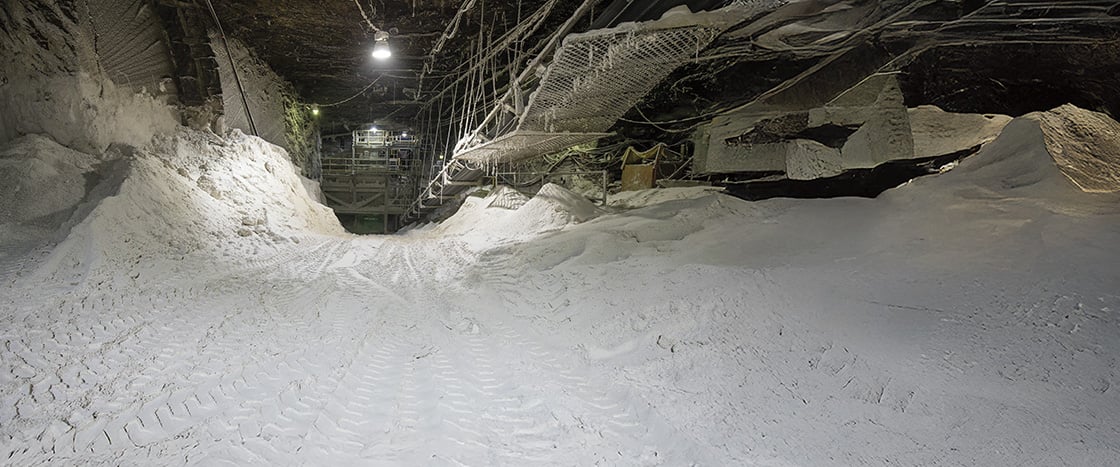
Workers use giant machines to move rock salt blasted from the walls of the mine.

Winter weather can make roads and sidewalks slippery. To make it easier to get around, U.S. cities and towns scatter nearly 20 million tons of salt on snowy streets and walkways each year. The salt helps melt the ice, so it’s safer to drive and walk. How do we get such a massive amount of salt? Much of it comes from a vast mine under Lake Erie, one of the Great Lakes.

The Morton Salt Mine lies near the town of Fairport Harbor, Ohio. Many locals don’t know it exists. Workers take a four-minute elevator ride down into the mine. They travel about 2,000 feet (610 meters) underground to reach its sparkling caverns and tunnels. Besides these workers, few people ever get to see inside. 

Winter weather can make roads and sidewalks slippery. But U.S. cities and towns have a way to make it easier to get around. They scatter salt on snowy streets and walkways. They spread nearly 20 million tons of it each year! It helps melt the ice. That makes it safer to drive and walk. Where do we get all that salt? Much of it comes from a huge mine. It’s under Lake Erie. That’s one of the Great Lakes.

The Morton Salt Mine lies near Fairport Harbor. That’s a town in Ohio. Many people who live there don’t even know about the mine. Mine workers take a four-minute elevator ride. It lowers them down to the mine. It’s about 2,000 feet (610 meters) below the ground. Then they reach the mine’s caverns and tunnels. The salt along the walls sparkles. Few people ever get to see inside besides these workers.

Ancient Formation

The salt deposits in this region are the result of slow changes over millions of years. About 544 million to 245 million years ago, the Great Lakes region looked very different. Much of North America was once covered in a shallow, salty sea.

In the Great Lakes region, huge rings of coral reefs rose above the water. The rings formed giant, bowl-shaped areas called basins. Salt water got caught inside them. Hot, dry air caused some of the water to evaporate. It turned from liquid water to water vapor, a type of gas. The salt was left behind. It sank to the seafloor. Over millions of years, water continued to slowly evaporate. A thick layer of salt formed. 

The salt deposits in the Great Lakes region formed slowly over time. The area looked very different about 544 million to 245 million years ago. A salty sea covered much of North America. Huge rings of coral reefs rose above the shallow water. They formed giant areas shaped like bowls. They’re called basins. Salt water got trapped inside them.

Hot and dry air caused some of the water to evaporate. It turned from a liquid into a gas. The gas is called water vapor. The salt was left behind. It sank to the seafloor. The water kept slowly evaporating. Millions of years passed. A thick layer of salt formed.

Hidden World

The Morton Salt Mine under Lake Erie is the deepest salt mine in North America. It covers an area about the size of 2,500 football fields. More than 1 million tons of this special mineral come from the mine each year. The mine has been in operation since the late 1950s.

No natural light reaches inside the mine. “If you turn all your lights off, it’s the darkest experience you’ll ever have,” says Ty Heinemann, the mine superintendent. “There’s not a trace of light anywhere.” The air is hot, dry, and dusty. “You can taste the salt in the air,” he says. 

To remove salt from the solid walls, miners use a method called room-and-pillar mining. They use explosives and large machinery to blast out huge caves, called caverns. They leave behind giant pillars of salt to support the rock ceiling and prevent it from collapsing. “Every time we break material, we are opening a place that has never been seen by another human,” says Heinemann.

The salt is crushed and sent above ground. It goes to a processing plant in Fairport Harbor. All of the mine’s salt is used for road salt. 

The Morton Salt Mine sits under Lake Erie. It’s the deepest salt mine in North America. The mine covers a huge area. It’s about the size of 2,500 football fields. The salt mine has been open since the late 1950s. Salt is a mineral. The mine produces more than 1 million tons of it a year.

No natural light reaches inside the mine. “If you turn all your lights off, it’s the darkest experience you’ll ever have,” says Ty Heinemann. He oversees the mine. “There’s not a trace of light anywhere.” The air is hot, dry, and dusty. “You can taste the salt in the air,” he says.

Miners remove salt from the solid walls. They use a special method. It’s called room-and-pillar mining. They use explosives and big machines. They blast away huge caves. They’re called caverns. The workers leave behind giant towers of salt. These hold up the rock ceiling. That way it doesn’t cave in. “Every time we break material, we are opening a place that has never been seen by another human,” says Heinemann.

The salt is crushed. It’s sent above ground. It goes to a plant in Fairport Harbor. All the mine’s salt becomes road salt.

SHUTTERSTOCK.COM

People spread salt on sidewalks to prevent ice from building up.

On the Road

Road salt helps prevent ice from forming on streets. It lowers water’s freezing point. That’s the temperature at which it changes from a liquid to a solid. Water normally turns to ice at 32°F (0°C). If you add salt to water, temperatures must dip much lower for it to freeze.

If ice is already on roads, salt helps it melt faster. Salt dissolves into melting snow and ice. The result is salty water called brine. The brine spreads and helps melt more ice. As more liquid water forms, more salt is added to keep it from freezing again. 

Road salt saves lives by preventing slippery roads. But it also has some negative effects. When salt gets into nearby water and soil, it can harm plants and crops. Salt also breaks down metal and concrete over time. It can damage roads and bridges. 

But for now, road salt is one of the best ways to protect people from ice. That’s one reason Heinemann loves his job. “The work that we do is critical to keeping others safe on the roads in the winter,” he says.

Road salt helps keep ice from forming on streets. It lowers water’s freezing point. That’s the temperature at which a liquid becomes a solid. Water normally turns to ice at 32°F (0°C). But not if you add salt. Then it must get much colder for water to freeze.

If ice is already on roads, salt helps it melt faster. Salt mixes into melting snow and ice. The result is salty water. It’s called brine. The brine spreads. It helps melt more ice. More salt is added to keep the water from freezing again.

Road salt saves lives by making roads less slick. But it also has some problems. Salt gets into nearby water and soil. It can harm plants and crops. Salt also breaks down metal and concrete over time. It can damage roads and bridges.

Still, road salt is one of the best ways to protect people from ice. That’s one reason Heinemann loves his job. “The work that we do is critical to keeping others safe on the roads in the winter,” he says.

Salt Mine
Watch a video about mining salt.
video (1)
Slideshows (1)
Activities (14)
Quizzes (1)
Answer Key (1)
Text-to-Speech