


Article
Bettmann/Getty Images

The Soil Protector

Here’s how one man taught farmers to make soil—and crops—healthier.

By Maggie Mead and Jess McKenna-Ratjen
From the February 2026 Issue
Other Focus Areas: Structure & Function

Standards

Illustration by Rafael Alvarez

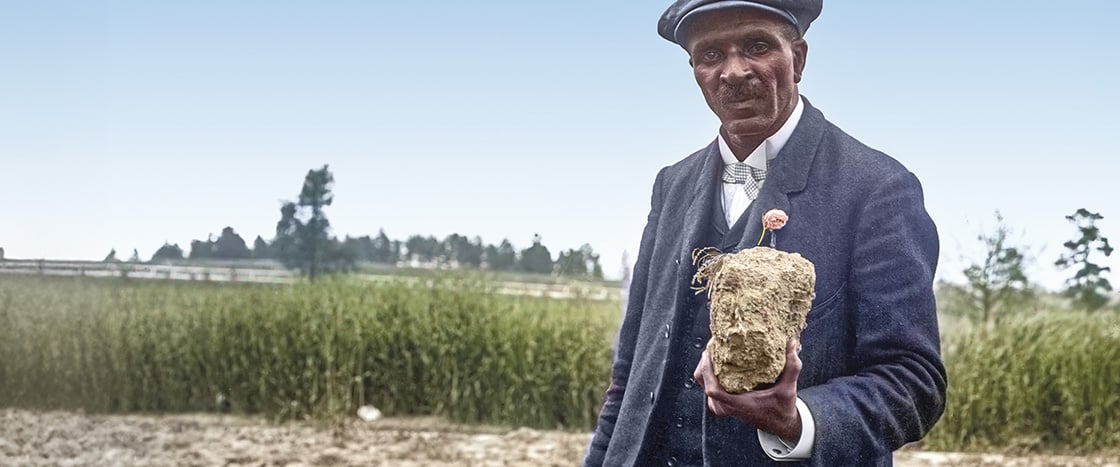
Carver taught farmers methods to make the soil healthier.

Cotton. Nothing but cotton plants. 

That’s all George Washington Carver could see through the window as his train sped south. Spindly stalks topped with round, white puffs covered acres and acres of land. 

The year was 1896. Carver was headed to the Tuskegee (tuh-SKEE-gee) Institute, a college in central Alabama. He was starting a new job as head of the school’s department of agriculture.

From a young age, Carver loved helping plants grow. Born to enslaved parents in 1864, he spent his childhood in rural Missouri. Locals called him the “Plant Doctor.” At age 30, he became the first Black American to earn an advanced science degree.

Seeing all that cotton worried Carver. Plants grow best in soil that’s packed with nutrients. But cotton plants soak up a lot of those nutrients. If farmers planted only cotton, the ground would eventually become hard and cracked. Nothing would grow anymore. Why were farmers planting so much cotton and almost nothing else?

King Cotton

Cotton plants thrived in the warm, humid climate of the American South. And cotton was a big business at the time! Since the 1600s, cotton’s fluffy fibers had been sold around the world to make clothing, furniture, and more. By 1896, farmers were growing cotton on 10 million acres of land across the South.

Many of the workers on these farms had been enslaved. They were freed after slavery became illegal, but they usually didn’t own the land where they worked. They were forced to share much of their earnings with White landowners. Cotton was one of the only crops that sold at a high enough price for Black farmers to survive.

Saving The Soil

When Carver arrived in Tuskegee, he talked to local farmers. He explained that crops like sweet potatoes, peanuts, and soybeans added an important nutrient called nitrogen to the soil. Plants need nitrogen to make food for themselves through a process called photosynthesis. If farmers planted the new crops every other year, the soil would become healthier. Then it could grow more cotton!

Illustration by Rafael Alvarez

Carver traveled with a mobile classroom he designed.

The Peanut Man

Farmers found that Carver’s strategy worked. But they had a new problem: People weren’t used to buying these new crops. How could the farmers still make money?

Carver got to work. He made a list of more than 350 ways people could use peanuts, from peanut oil to peanut soap! He became known as the “Peanut Man.”

Carver continued to research ways to help farmers across the U.S. Before his death in 1943, Carver donated his life’s savings to create a school to study farming at Tuskegee.

Carver was a true Earth Day hero, long before Earth Day even existed!

Inventors
Watch a video about famous inventors and their inventions.
video (1)
Activities (2)
Answer Key (1)
Text-to-Speech