Invented in Mesopotamia Around 3500 B.C.
Invented in Mesopotamia Around 3500 B.C.
Every human-made object around you began as an idea—a solution to a problem. Some inventions altered the course of human history! And they might not be what you expect . . .
Learning Objective: Students will describe five important inventions and debate which one was most significant.

LOAD CARRIER: Wheel and Axle
Invented in Mesopotamia Around 3500 B.C.
Invented in Mesopotamia Around 3500 B.C.
JIM MCMAHON/MAPMAN ®
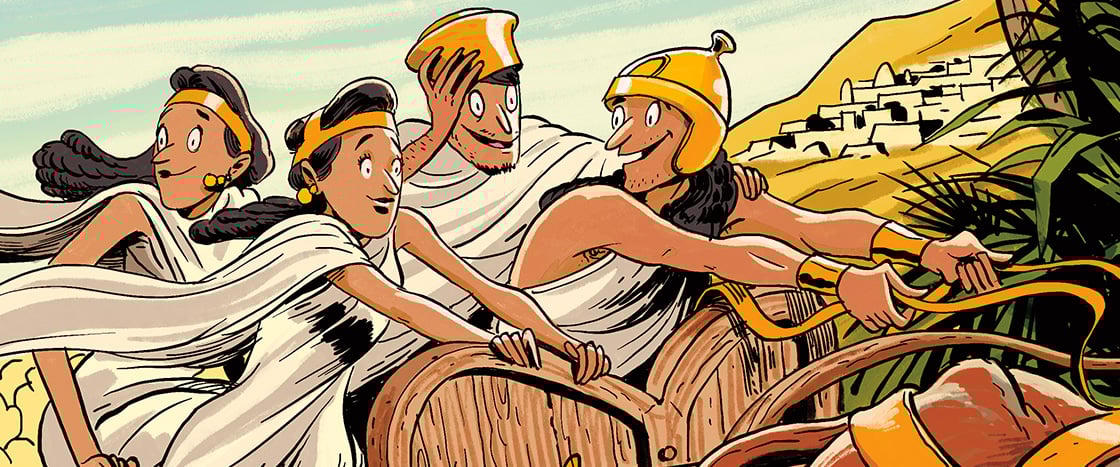
Ready, HEAVE! Until the wheel was invented, moving heavy stones, a pile of goods, or a loaded cart took major muscle power. The wheel made it easier to move heavy items. That’s why it may be humans’ greatest invention.
But a wheel isn’t so effective by itself. It needs to turn on a pole called an axle. Who put the wheel and axle together? It was probably people in ancient Mesopotamia. Today this area includes Iraq and parts of Iran, Kuwait, Syria, and Türkiye (Turkey).
Before wheels existed, a whole village may have worked together to move stones, lumber, or crops. By using wheels, fewer people were needed to get things done. People could spread out over a larger area. They could also move large amounts of goods farther on carts. Trade spread to new places.
Ready, PUSH! Heavy stones. A pile of goods. A loaded cart. Long ago, moving any of these took major muscle power. Then the wheel was invented. It made it easier to move heavy items. That’s why it may be humans’ greatest invention.
But a wheel isn’t very useful by itself. It needs to turn on a pole, or axle. Who put the wheel and axle together? It was probably people in ancient Mesopotamia. Today this area includes Iraq. It also contains parts of Iran, Kuwait, Syria, and Türkiye (Turkey).
A village worked together to move things before wheels existed. They moved stones, lumber, or crops. With wheels, fewer people were needed to get things done. People could spread out. They could move more goods farther. And trade spread to new places.
RECORD KEEPER: Paper
Invented in Egypt Around 3000 B.C.
Invented in Egypt Around 3000 B.C.
JIM MCMAHON/MAPMAN ®
Quick! You need to jot down something important. Now grab a pointy tool and spend hours carving your note into a clay tablet. Before the invention of paper, that’s what some people did!
The first paper was invented in Egypt, where a tall green reed called papyrus grew on the banks of the Nile River. Ancient Egyptians used papyrus to build huts, temples, and boats. But then, about 5,000 years ago, they tried making something new out of papyrus—paper.
Workers sliced papyrus stems into thin layers, then overlapped them to form a sheet. When pressed and dried, each sheet formed a page. People wrote on papyrus paper with reed pens dipped in ink.
The Egyptians kept this method a secret. They sold their invention to others for thousands of years. People used the paper to record news, make records, and write works of literature. Today we study those papyrus records as ancient history.
Quick! You need to write down something important. Grab a pointy tool. Then spend hours carving your note into a clay tablet. That’s what some people did before the invention of paper!
The first paper was created in Egypt. The Nile River flows through the area. A tall green reed grows along its banks. It’s called papyrus. Ancient Egyptians used it to build huts, temples, and boats. Then about 5,000 years ago they made something new. They turned papyrus into paper.
Workers cut papyrus stems into thin layers. They overlapped the layers to form a sheet. It was pressed and dried to form a page. People wrote on papyrus paper with reed pens. The pens were dipped in ink.
The Egyptians kept this method a secret. They sold their invention to others. This went on for thousands of years. People used the paper to write news, records, and stories. Today those writings help us learn about ancient history.
WRITING TOOL: Pencil
Invented in England in the 1500s
Invented in England in the 1500s
JIM MCMAHON/MAPMAN ®
Messy inkblots. Scribbled-over mistakes. Until the invention of the pencil, people wrote with ink-dipped quill pens often made of goose or swan feathers.
In the 1500s, people in England found a shiny black mineral in the ground. It later came to be called graphite. The material was good for making marks. So people cut it into thin sticks and wrote with them.
Inventors made the first pencils by surrounding a stick of graphite with carved pieces of wood. As production methods improved, the pencil’s popularity soared.
Pencils were cheap and simple to use. Artists, scientists, and everyday people could record their ideas. Mistakes were easier to fix too, especially after another invention in the 1770s—the rubber eraser!
Messy inkblots. Crossed-out mistakes. Both happened when writing with quill pens. They were made from bird feathers and dipped in ink. Then the pencil was invented.
People in England found something in the 1500s. It was a shiny black mineral. It came to be called graphite. The mineral was good for making marks. So people cut it into thin sticks. They wrote with them.
Inventors covered sticks of graphite with carved pieces of wood. The pencil was born. Methods to make pencils improved. And their popularity soared.
Pencils were cheap and easy to use. Artists, scientists, and regular people could record their ideas. Mistakes were easier to fix too. That’s thanks to an invention in the 1770s. It was the rubber eraser!
NAVIGATION AID: Compass
Invented in China Around 1000 A.D.
Invented in China Around 1000 A.D.
JIM MCMAHON/MAPMAN ®
Long before you could use a mapping app to navigate places, ancient people had only the sun and stars to guide them. And they got lost. A lot! The invention of the compass was a game changer.
Ancient Chinese thinkers thought naturally magnetic rocks had magic properties. Balanced on a bronze plate, these spoon-shaped rocks would spin to align with north and south. About 1,000 years later, scholars rubbed the rocks against needles to make them magnetic. The needles were used to make the first compass.
The compass allowed voyagers to follow a set course without getting lost. It also helped people more easily transport goods long distances. This led to more trade. Today planes, cars, and ships still use digital compasses to navigate all over the world!
Today we use mapping apps to navigate to places. But ancient people had only the sun and stars to guide them. And they got lost. A lot! The compass was a game changer.
Ancient Chinese thinkers knew of magnetic rocks. They thought the rocks had magic properties. These spoon-shaped rocks could be balanced on a bronze plate. They’d spin to align with north and south. Scholars rubbed the rocks against needles about 1,000 years later. This made the needles magnetic. The needles were used to make the first compass.
The compass allowed travelers to follow a set course. So they didn’t get lost so much. It also helped people more easily move goods over long distances. This led to more trade. We still use digital compasses. They allow planes, cars, and ships to navigate the world!
BOOKMAKER: Printing Press
Invented in Germany Around 1439
Invented in Germany Around 1439
JIM MCMAHON/MAPMAN ®
Talk about a hand cramp! Before the early 1400s, making a new copy of a book meant writing it by hand. German inventor Johannes Gutenberg had a better idea.
He developed a printing press with individual metal letters. They could be moved around and reused many times. People could print a full page of text at once—up to 250 pages an hour!
For the first time, printed material could be created on a large scale. Gutenberg’s invention made books more affordable. Ideas in art, culture, and science spread, leading to more inventions!
Talk about a hand cramp! Books were copied by hand before the early 1400s. German inventor Johannes Gutenberg had a better idea.
He created a printing press. It used metal letters. They could be moved around and reused many times. People could print a full page of text at once. They could make up to 250 pages an hour!
Printed works could be made on a large scale. It was a first! Gutenberg’s invention made books cheaper. Ideas in art, culture, and science spread. That led to more inventions!