

What is this thing in the snow? Pick the explanation you think is correct. Give three reasons to support your answer.
A. Ice and snow froze around a tree.
B. A person carved a sculpture out of ice and snow.
C. Someone started building an igloo.
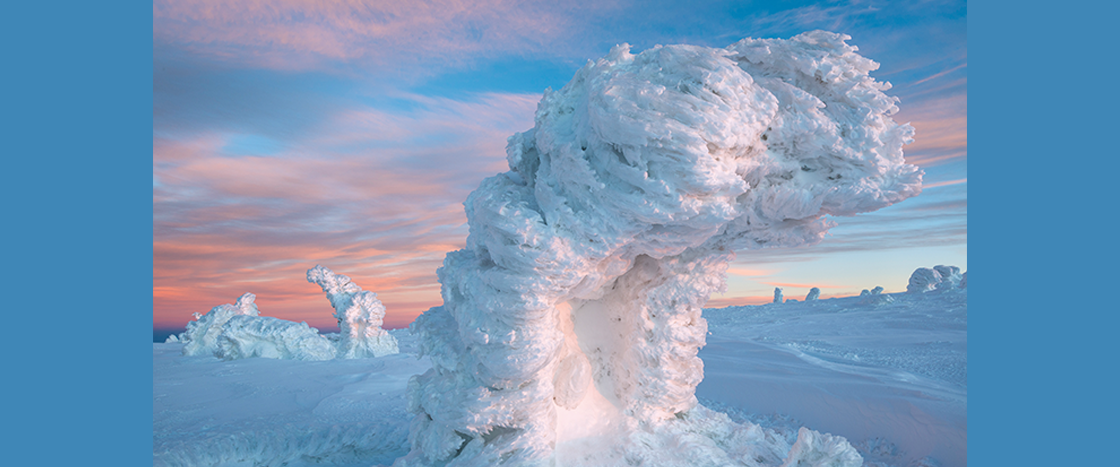
Can you explain what's happening in this strange photo?

Orsolya Haarberg/NaturePL.com
What is this thing in the snow? Pick the explanation you think is correct. Give three reasons to support your answer.
A. Ice and snow froze around a tree.
B. A person carved a sculpture out of ice and snow.
C. Someone started building an igloo.
Pause your scrolling. Think about three reasons to support your answer.
Orsolya Haarberg/NaturePL.com (Snow Tower); Sorapop Udomsri/Shutterstock.com (Child)
Now let’s find out what’s really going on . . .
Orsolya Haarberg/NaturePL.com (Snow Tower); Shutterstock.com (Spark)
If you answered A, you’re right!
There’s something hidden within this unusual structure of ice and snow. It’s a spruce tree! The plant is located in the Carpathian Mountains of Romania. That’s a country in eastern Europe.
Being trapped inside a frozen shell like this would damage or even kill other types of trees. But not a spruce tree! They’re conifers—trees that produce their seeds in cones instead of fruits or nuts. Conifers have adapted to survive in very cold temperatures.
K J/Alamy Stock Photo
The leaves of a conifer tree are called needles. They have special adaptations for surviving in cold, snowy conditions.
Most conifers are evergreen, meaning they don’t shed their leaves during cold months. Their thin, waxy leaves—called needles—lock in moisture. The plants use this stored water during the winter when water in the ground is frozen.
Daniel Prudek/Alamy Stock Photo
A deciduous tree.
Trees that aren’t conifers are called deciduous (duh-SIH-joo-us) trees. They thrive in temperate climates. That means the climate includes four seasons, and the weather is hardly ever extremely hot or extremely cold. Deciduous trees have broad, flat leaves, which fall off in autumn. By not needing to send nutrients to their leaves over the winter, the tree conserves energy.
If a deciduous tree becomes covered in ice before losing its leaves, the plant could die. That’s because the frozen leaves can become so heavy that branches break. Or the entire tree could fall over.
Richard Smith/Alamy Stock Photo
This deciduous tree became covered in ice and collapsed under its extra weight.
The needlelike shape of a conifer’s leaves prevents them from trapping too much heavy snow and ice. Conifers also have flexible branches that can bend under the weight of snow without breaking.