
To discover a new galaxy, you’d become an astronomer—a scientist who studies space. You’d create maps of galaxies and their parts, including stars, black holes, and clouds of gas and dust. You’d also observe how these parts slowly move and grow over time.
Back to Teacher View
Student View
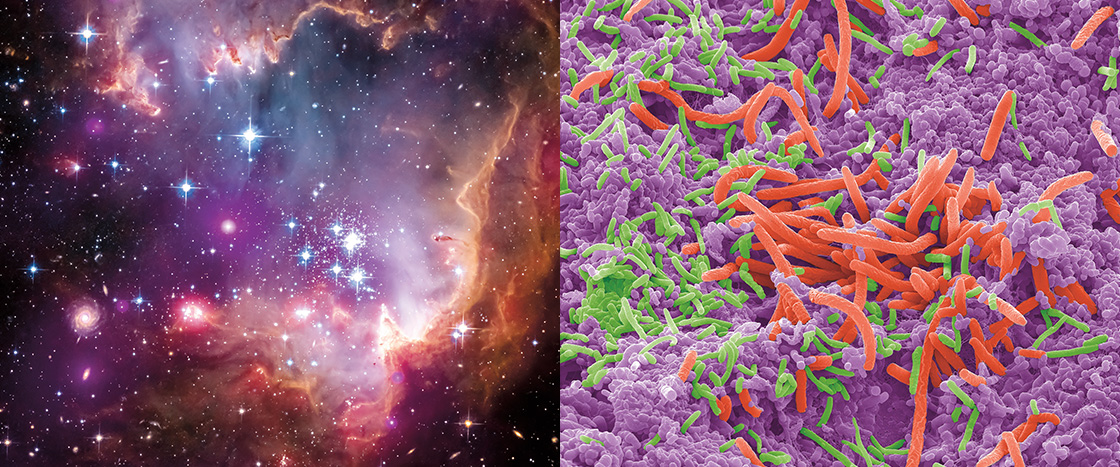
NASA/CXC/JPL-Caltech/STScI (galaxy); STEVE GSCHMEISSNER/SCIENCE PHOTO LIBRARY/Getty Images (microbes)
Would You Rather Discover a Dazzling Galaxy or a Mysterious Microbe?
At mind-boggling distances from Earth, giant galaxies swirl through space. Much closer, tiny microbes exist everywhere—even inside your body! Which sounds more thrilling: hunting for discoveries in the cosmos or in the microscopic world on Earth?
By Alice Sun and Jess McKenna-Ratjen
From the February 2026 Issue
Learning Objective: Students will gather and use information about how scientists study giant galaxies and tiny microbes to support an argument.
Other Focus Areas: Solar System and Universe, Structure and Function
Standards

Would You Rather Discover a Dazzling Galaxy or a Mysterious Microbe?
Watch a video to help you make your choice.
A DAZZLING GALAXY
WALTER PACHOLKA, ASTROPICS/SCIENCE PHOTO LIBRARY
This powerful telescope in Hawaii uses lasers to help astronomers study distant stars.
WHAT YOU’D STUDY
TOOLS YOU’D USE
Astronomers study galaxies using special instruments that detect waves of light and gravity in space, as well as photos and data from powerful telescopes. Space telescopes can take the clearest pictures. That’s because they orbit Earth outside its atmosphere, the layer of gases surrounding our planet.
WHERE YOU MIGHT WORK
You might peer into space directly by traveling to one of a few dozen gigantic telescopes here on Earth, such as the W.M. Keck Observatory in the mountains of Hawaii (above). Or you might use the data from space telescopes and other instruments for your search. You’d spend most of your time in a computer lab, using math to figure out what’s happening far away.
WHAT YOU COULD DISCOVER
There may be as many as 20 trillion galaxies in the universe. In the tiny fraction scientists have studied so far, they’ve found amazing things. You could discover a galaxy with clouds of gas and dust where stars are born, or a gigantic black hole where gravity is strong enough to trap light. Plus, it takes millions of years for a faraway galaxy’s light to reach Earth. You could find clues about how the universe formed!
A MYSTERIOUS MICROBE
STEVE GSCHMEISSNER/Science Source
These bacteria were found on the door handle of a train!
WHAT YOU’D STUDY
To discover a new microbe, you’d become a microbiologist—a scientist who studies microbes, including bacteria, viruses, and some types of fungi. You’d collect them from different environments and plan experiments to learn more about them and how they affect the world around us.
TOOLS YOU’D USE
Microscopes allow scientists to see what microbes look like and how they work. To help microbes grow, you’d place them in a special warming device called an incubator. You might use many tools for experiments, such as test tubes, hot plates, and special stirring machines.
WHERE YOU MIGHT WORK
Microbes live almost everywhere on Earth. So you might travel the world collecting samples, such as Arctic snow or soil from the Amazon. But you’d spend most of your time in a lab. You’d need to wear special protective clothing and keep all your tools completely clean. Otherwise, microbes from your body could become part of your experiments!
WHAT YOU COULD DISCOVER
Microbes affect our climate, our health, and the environment. You might find a new type of fungus that can eat through plastic. It could become the best way to clean up plastic waste. If you found a deadly new virus, you could help create a vaccine to protect humans from it. A new bacterium discovered in Arctic ice might help scientists learn how life could exist on other, colder planets. Plus, you could name the microbe you discover!
What does your class think?
Which would you rather discover?
Which would you rather discover?
Which would you rather discover?
0%
0votes
{{result.answer}}
Total Votes: 0
video
(1)
Games
(1)
Activities
(2)
Skills Activities
Answer Key
(1)

Text-to-Speech