

Article
Shutterstock.com

I'm Flying Around the Moon!

Victor Glover will pilot a spacecraft for an upcoming moon mission.

By Dani Leviss
From the March/April 2026 Issue

Learning Objective: Students will summarize how and why an astronaut uses skills like communication and coding in their job. 

Lexile: 860L; 580L

Standards

Download and Print
Would You Like to Be an Astronaut?
Watch a video about what it's like to be an astronaut.

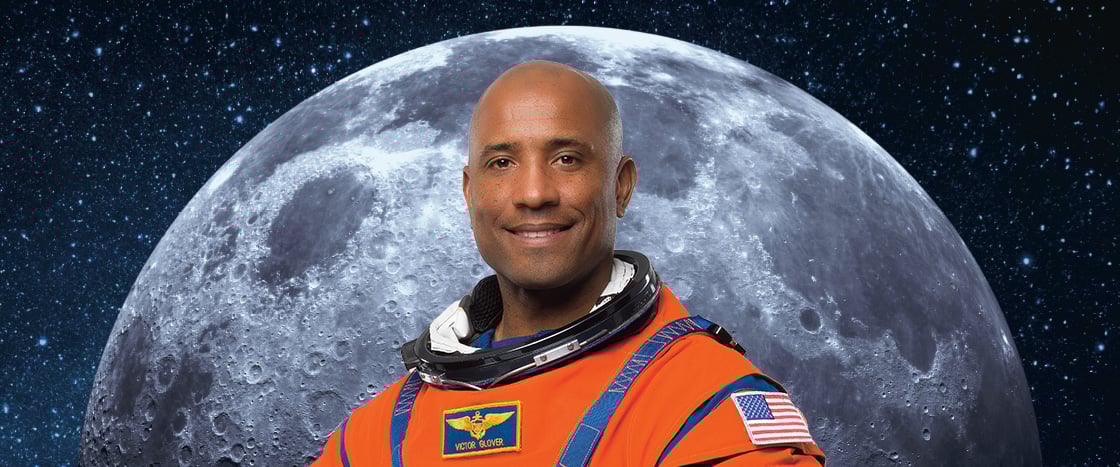
ROBERT MARKOWITZ/ NASA-JOHNSON SPACE CENTER

Victor Glover

When Victor Glover was 10 years old, his backyard was his favorite place to be at night. He’d stare at the bright glow of the moon and spot shapes in its craters. He also watched rocket launches on TV and imagined what life was like for the astronauts inside. “That was what helped me understand what it meant to be a hero,” he says. 

As an adult, Glover joined the military and trained to become a pilot. When he heard a NASA astronaut speak at a conference, he realized many of his skills matched hers. He applied to become an astronaut. It took two tries, but in 2013 he was accepted!

In 2018, Glover flew a spacecraft to the International Space Station, where he lived and worked for 168 days. Now he’s training for a mission called Artemis II. Planned for sometime in 2026, Glover will pilot a spacecraft, called Orion, in a loop around the moon. He and his three crewmates will be the first humans to fly near the moon in more than 50 years! Glover spoke with SuperSTEM about what it takes to become an astronaut and his upcoming mission.

Victor Glover had a favorite place to be at night when he was 10 years old. It was his backyard. He’d stare at the bright glow of the moon. He’d spot shapes in its craters. He also watched rocket launches on TV. He’d imagine what life was like for the astronauts inside. “That was what helped me understand what it meant to be a hero,” he says.

Glover joined the military as an adult. He trained to become a pilot. Then he heard a NASA astronaut talk at a meeting. He realized many of his skills matched hers. He applied to become an astronaut. It took two tries. But in 2013 he was accepted!

Glover flew a spacecraft to the International Space Station in 2018. He lived and worked there for 168 days. Now he’s training for a mission called Artemis II. It’s planned for 2026. Glover will pilot a spacecraft. It’s called Orion. It will loop around the moon. He’ll have three crewmates.  They’ll be the first people to fly near the moon in more than 50 years! Glover spoke with SuperSTEM about what it takes to be an astronaut and his upcoming mission.

ESA–M. Cowan 

The Orion crew capsule will carry the Artemis II crew around the moon and back to Earth.

How does someone become a NASA astronaut?

First you must meet some basic requirements. NASA astronauts have either a medical degree or a master’s degree in a STEM field such as computer science or engineering, and have some experience in that field. They also have to pass a physical test, which checks your eyesight, hearing, and overall health.

A lot of people can meet those basic requirements. Thousands apply, but only a handful get selected. To stand out, you need to be a strong leader and work well with a team. It’s important to be reliable and treat the people around you well.

There are some basic things you need. NASA astronauts have either a medical degree or a master’s degree in a STEM field. For example, computer science or engineering. And they need to have done some work in that field. They also must pass a physical test. It checks your eyesight, hearing, and overall health.

Thousands of people apply. But only a handful get picked. You need to be a strong leader to stand out. And you need to work well with a team. It’s important to be reliable and treat the people around you well.

What’s your job as a space pilot?

As a pilot, it’s my job to know what’s going on with the vehicle I’m driving at all times. Space missions have a few tricky stages. For example, when a spacecraft launches, changes direction, or lands, you need to blast the engines for a specific amount of time. I need to know whether the spacecraft is doing what it’s supposed to at the right times. If I notice that the vehicle is doing something wrong, I try to fix it.

A spacecraft is made up of a lot of machines that use code, or sets of instructions that tell computers what to do. I work with these machines to check on the spacecraft and direct it where I want it to go.

It’s my job to know what’s going on with the vehicle I’m driving at all times. Space missions have a few tricky stages. For example, when a spacecraft launches, changes direction, or lands. You need to blast the engines for a specific amount of time. I need to know if the spacecraft is doing what it’s supposed to at the right times. I try to fix anything the vehicle is doing wrong.  

A spacecraft is made up of a lot of machines. Many use code. These sets of instructions tell computers what to do. I work with these machines to check on the spacecraft. They allow me to direct it where I want it to go.

NASA/Mark Sowa

Artemis II astronauts train in a mock space vehicle. They’re in pressure suits practicing to re-enter Earth’s atmosphere after returning from the moon.  

What’s the purpose of the Artemis II mission?

I like to think of the Artemis II mission as part of a relay race. Artemis I was the first leg (see Moon Milestones). It proved Orion could fly around the moon. Now the baton is passed to me and my crew. We’re going to fly inside Orion on a 10-day mission where we’ll loop around the moon and return to Earth. If that’s successful, we’ll pass the baton to future missions that may land on the moon.

I like to think of the Artemis II mission as part of a relay race. Artemis I was the first leg (see Moon Milestones). It proved Orion could fly around the moon. Now the baton is passed to me and my crew. We’re going to fly inside Orion on a 10-day mission. We’ll loop around the moon and return to Earth. We’ll pass the baton to future missions if that’s successful. They may land on the moon.

How are you training for this mission?

We’re training for the trip in phases. First we learned about the basic parts of the spacecraft. Then we learned how to fly it. Now we’re using a simulator that models what it will be like when we launch, land, and more. We also dangle from harnesses attached to tall cranes to practice working while weightless. In space, we’ll be floating most of the time.

We’re training for the trip in stages. First we learned about the basic parts of the spacecraft. Then we learned how to fly it. Now we’re using a simulator. It models what it will be like when we launch, land, and more. We also practice working while weightless. We dangle from harnesses attached to tall cranes. We’ll be floating most of the time in space.

Why is it important to travel to the moon?

The Apollo 11 astronauts brought rocks back from the moon. We’re still making discoveries about those same rocks, 50 years later.

Sending humans back to the moon is going to give us even more tools to study it. The Apollo missions only covered a small area about the size of Houston, Texas. The goal of the Artemis missions is to explore new areas, especially the poles. NASA scientists think there might be ice there. If that’s true, chemicals from thousands or millions of years ago could be frozen inside. That could tell us more about the history of the moon, which also helps us learn about the history of Earth.

The Apollo 11 astronauts brought rocks back from the moon. It’s been 50 years since then. We’re still making discoveries about those same rocks.

Now we’re sending humans back to the moon. We’ll have even more tools to study it. The Apollo missions only covered a small area. It was about the size of Houston, Texas. The goal of the Artemis missions is to explore new areas of the moon. That includes the poles. NASA scientists think there might be ice there. Chemicals from thousands or millions of years ago could be frozen inside if that’s true. That could tell us more about the history of the moon. And it also helps us learn about the history of Earth.

What do you love about being an astronaut?

What I love most about being an astronaut doesn’t have anything to do with space. When you leave the planet, you represent all people. I think it’s so important to be in touch with your own humanity because it helps us recognize the humanity in other people.

We interact with people from all over the country and the world. We visit classrooms and talk to students. When young people think about the future, I hope the Artemis II mission can be a bright example of what we all can accomplish when we work together and do our best.

What I love most about being an astronaut doesn’t have anything to do with space. You represent all people when you leave the planet. I think it’s so important to be in touch with your own humanity. It helps us see the humanity in other people.

We meet people from all over the country and the world. We visit classrooms and talk to students. Young people are thinking about the future. I hope the Artemis II mission can be a bright example of what we all can achieve when we work together and do our best.

video (1)
Games (1)
Activities (2)
Answer Key (1)
Text-to-Speech