


Article
Shutterstock.com (Orange Mycena Mushroom); Stephane Vitzthum/Biosphoto/Minden Pictures (Snail)

Are You Friends With Fungi?

Let’s get to know nature’s cleanup crew!

By Mara Grunbaum and Jess McKenna-Ratjen
From the March/April 2026 Issue

Learning Objective: Students will explain why fungi are an important part of ecosystems.

Lexile: 900L; 630L

Standards

Download and Print
The Fungus Among Us
Watch a video about fungi.

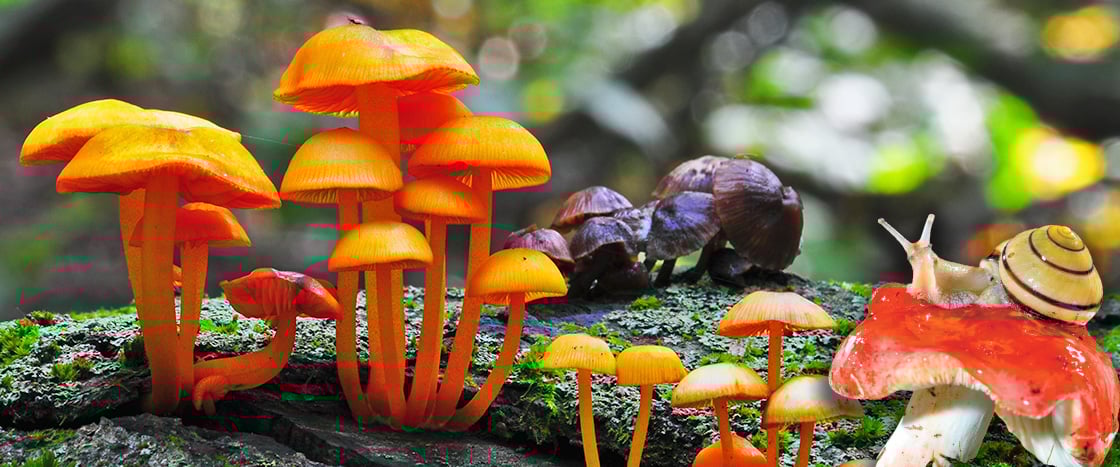
Have you ever eaten a mushroom? If so, you’ve tasted a fungus (FUHNG-guhs)—an organism that’s neither an animal nor a plant! There are hundreds of thousands of known fungi (FUHN-gy) species, including mushrooms, mold, and yeast. Some are made of a single microscopic cell. Others are tangled masses as big as whole towns!

Many fungi appear similar to plants, with parts that look like stems or roots. But don’t be fooled! They’re more closely related to animals, explains Sydney Glassman, an ecologist who studies fungi. Fungi can’t make their own food like plants do. Instead, they get food from their environment like animals. And we’re all very lucky that they do!

Have you ever eaten a mushroom? If so, you’ve tasted a fungus (FUHNG-guhs). It’s a living thing that’s not an animal or a plant! There are hundreds of thousands of known fungi (FUHN-gy) species. They include mushrooms, mold, and yeast. Some are made of a single cell. They’re too small to see. Others are masses as big as whole towns!

Many fungi have parts that look like plants’ stems or roots. But don’t be fooled! They’re more closely related to animals, says Sydney Glassman. She’s an ecologist. She studies fungi. Fungi can’t make their own food like plants do. Instead, they get food from their surroundings like animals. And we’re all very lucky that they do!


Some fungi are poisonous. NEVER eat a mushroom you find growing in the wild!

A Dirty Job

When plants and animals die, they don’t just disappear. They decay, or slowly break down over time until few parts remain. But this process doesn’t happen on its own. It’s made possible by a special group of organisms called decomposers (see Vocab Lab), which includes worms, bacteria, and most types of fungi.

“If fungi didn’t exist, you’d just be up to your ears in dead stuff,” says Glassman.

Fungi are nature’s recyclers. They often grow underground or inside wood, where they release chemicals that break down dead things. Dead animals and plants give decomposers the energy and nutrients they need to survive.

While they get a meal, decomposers put nutrients like potassium and nitrogen back into the environment.  Without fungi and other decomposers, precious nutrients would be lost for good, locked up in dead things.

Plants and animals don’t just disappear when they die. They decay. That means they slowly break down over time until few parts remain. But this process doesn’t happen on its own. It’s made possible by living things called decomposers (see Vocab Lab). They include worms, bacteria, and most types of fungi.

“If fungi didn’t exist, you’d just be up to your ears in dead stuff,” says Glassman. Fungi are nature’s recyclers. They often grow beneath the ground or inside wood. They release chemicals. They break down dead things. Dead animals and plants give decomposers energy and nutrients. That’s how they survive.

Decomposers also put potassium and nitrogen back into the environment. These precious nutrients would be lost for good without decomposers. They’d remain locked up in dead things.

Hidden Giants

How do small fungi like mushrooms and mold break down so much dead material? For many fungi, the parts you see are only a tiny piece of their full bodies!

The main part of any fungus is its mycelium (my-SEE-lee-uhm)—a giant network of rootlike threads. These threads are often invisible to the human eye. Visible parts of the fungus, like mushrooms, grow from mycelium, and allow the fungus to reproduce.

Fungi like mushrooms and mold are small. So how do they break down so much dead stuff? The parts of many fungi you see are only a tiny piece of their full bodies!

The main part of any fungus is its mycelium (my-SEE-lee-uhm). It’s a giant mesh of rootlike threads. These threads are often invisible to the human eye. Mushrooms are visible parts of a fungus. They grow from mycelium. Mushrooms allow the fungus to reproduce.

“Mushrooms pop up in different places, but they’re all connected underground,” says Glassman.

A single mycelium network can spread across incredibly large areas. One honey fungus in Oregon spans nearly 4 square miles (10 square kilometers). That’s about five times the size of Disneyland in California! Some scientists think it’s the largest living organism on the planet.

“Mushrooms pop up in different places,” says Glassman. “But they’re all connected underground.” A single mycelium network can spread across a huge area. There’s a honey fungus in Oregon. It spans nearly 4 square miles (10 square kilometers). That’s about five times the size of Disneyland in California! Some scientists think that honey fungus is the largest living organism on the planet.

Wild and Wonderful

Scientists estimate Earth is home to at least 2 million species of fungi. Only a small fraction of them—about 7 percent—have been identified. Researchers discover about 2,000 new fungus species each year! Each one is a win for science and for people. That’s because fungi do a lot of good in addition to their role as decomposers, says Glassman.

Yeast, a single-celled fungus, makes bread fluffy. Certain molds give flavor to foods like soy sauce and blue cheese. Some medicines are made with chemicals produced by fungi (see Made With Fungi). Some fungi can even break down metal and plastic! In the future, fungi may be used to reduce pollution.

Whether you love to see mushrooms on your pizza or you’d rather not bite into one, there are many reasons to appreciate them and their fellow fungi! Without them, it would be much harder for living things to survive.

Scientists believe Earth is home to at least 2 million species of fungi. Only about 7 percent have been identified. Scientists discover about 2,000 new fungus species each year! Each one is a win for science and for people. The reason is that fungi aren’t just important decomposers, says Glassman. They’re helpful in many other ways.

Yeast is a single-celled fungus. It makes bread fluffy. Certain molds give flavor to foods. They include soy sauce and blue cheese. Some medicines are made with chemicals created by fungi (see Made With Fungi). Some fungi can even break down metal and plastic! Fungi may be used to reduce pollution in the future.

video (1)
Slideshows (1)
Activities (13)
Quizzes (1)
Answer Key (1)
Text-to-Speech