
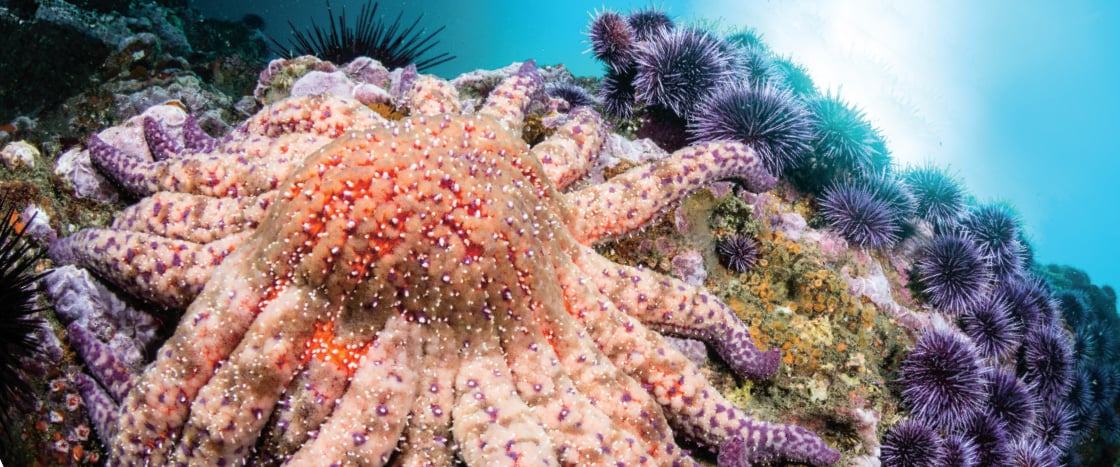

For Jason Hodin, the crabs, kelp, and sea stars in the waters outside his laboratory are like his co-workers. Hodin, a marine biologist at the University of Washington in Washington State, studies these species. So when a spectacular type of sea star started disappearing, Hodin took it personally.
Sunflower sea stars once lived all along the Pacific coast (see Sunflower Sea Star Range). But starting in 2013, they began to get sick and die in huge numbers. People along the coast stopped seeing them on beaches.
“They were everywhere, and then suddenly they were nowhere,” says Hodin.
Scientists were baffled. What could be killing sunflower stars so quickly? Could it be stopped? If not, what would happen to the rest of the ecosystem?
Crabs, kelp, and sea stars live in the waters outside Jason Hodin’s laboratory. They’re like his co-workers. Hodin studies these species. He’s a marine biologist. He works at the University of Washington in Washington State. But one kind of sea star started disappearing. Hodin took the loss of his co-worker personally.
Sunflower sea stars once lived all along the Pacific coast (see Sunflower Sea Star Range). But they began to get sick starting in 2013. They died in large numbers. People along the coast stopped seeing them on beaches.
“They were everywhere, and then suddenly they were nowhere,” says Hodin. Scientists were puzzled. What could be killing sunflower stars so quickly? Could it be stopped? If not, what would happen to the rest of the ecosystem?