

Being awake during the day means living in a world of light—and color! Like humans, most diurnal animals have eyes adapted to sense visual information, like colors and movement. These abilities are especially important for spotting predators or finding prey.
Back to Teacher View
Student View
Would You Rather Experience Only Day or Only Night?
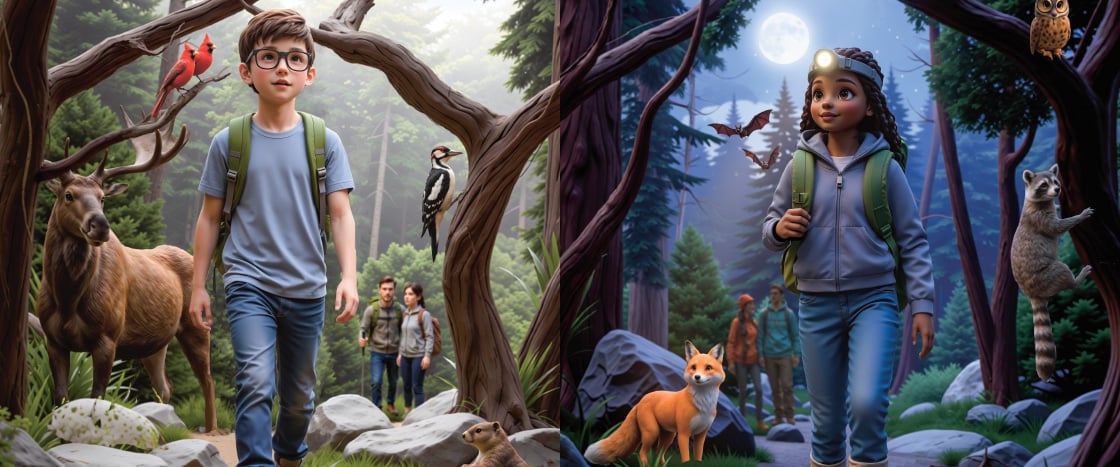
As Earth rotates, sunny days turn into starry nights. Like humans, some animals are diurnal, or active during the day. Others are nocturnal, or active at night. If you had to choose, would you rather see only the sun or the night sky?
By Jess McKenna-Ratjen, Illustrated by Peter Bollinger
From the March/April 2026 Issue
Learning Objective: Students will gather and use information about diurnal and nocturnal adaptations to support an argument.

ONLY DAY
Illustrated by Peter Bollinger
LIGHT LEVEL
TEMPERATURE CHECK
Sunlight isn’t just bright. It’s also hot! Diurnal animals are awake during the warmest time of day. In warmer climates, daytime animals have to keep cool. They might roll in mud, stay in the shade, or guzzle water.
ACTIVITY AMOUNT
The daytime world is busy! Bees hum, birds sing, and billions of humans talk, drive, and build when it’s light out. With so many diurnal animals awake, resources such as territory, food, and water need to be shared. Competition can be fierce!
WHAT IT WOULD BE LIKE
Humans are naturally diurnal, so your life wouldn’t change much. You would wake up with the rising sun. You’d step out into a bright morning, ready to start your day. There would be a lot to do, from visiting friends to going for a bike ride. Once the sun sets, you’d start to feel sleepy. Ready to rest, you’d crawl into bed to sleep through the night.
ONLY NIGHT
Illustrated by Peter Bollinger
LIGHT LEVEL
Nocturnal animals’ eyes often seem to glow in the dark. Why? Structures inside act like a mirror, picking up extra light. This helps animals see movement and shapes in the dark. But many nighttime creatures don’t rely on sight alone. Keen senses of smell, taste, and hearing help them move through the dark with ease.
TEMPERATURE CHECK
No matter where you live, temperatures drop when the sun sets. Nocturnal animals don’t need to worry about sunburns or heat stroke! But they do need to worry about keeping warm. That’s why many have thick fur.
ACTIVITY AMOUNT
At night, the world is quieter and less competitive. But it can be dangerous. Owls on the hunt glide silently through the trees. Mice scurry over the forest floor on soft feet. The tiniest noise could alert a predator or scare away prey.
WHAT IT WOULD BE LIKE
You’d wake up as the sun goes down. The night air can be nippy, so you’d likely bundle up before heading out. You’d be among night-blooming flowers and night-loving creatures like opossums. You could gaze at the stars or search for critters that glow in the dark. As dawn approaches and the sun starts to rise, you’d feel sleepy. As Earth turns and night fades into day, you would start your slumber.
What does your class think?
Which would you rather experience?
Which would you rather experience?
Which would you rather experience?
0%
0votes
{{result.answer}}
Total Votes: 0
Games
(1)
Activities
(2)
Skills Activities
Answer Key
(1)

Text-to-Speech