


Article
Shutterstock.com (Background); SLAC NATIONAL ACCELERATOR LABORATORY (Telescope)

Cosmic Close-Ups

Read a short science news article about a new telescope.

By K.R. Galloway
From the May/June 2026 Issue

Standards

Olivier Bonin/SLAC National Accelerator Laboratory (Observatory); Jim McMahon/Mapman® (Globe)

The observatory is on the peak of an 8,000-foot-tall mountain in Chile.

AIP Emilio Segre Visual Archives/Science Source

Vera Rubin

The world’s largest digital camera has started snapping picture after picture from a lofty mountaintop in South America. It’s pointed at an incredibly vast subject—space!

The car-sized camera sits in a giant telescope that’s part of the new Vera C. Rubin Observatory in Chile. It’s named after an American astronomer who made important discoveries about galaxies and the universe. Her decades-long career started in the 1960s.

RubinObs/NOIRLab/SLAC/NSF/DOE/AURA 

These clouds of gas and dust are trillions of miles from Earth. But the Vera C. Rubin Observatory captures them in amazing detail!

Last June, astronomers revealed the telescope’s first images. They show stunning views of outer space, including colorful clouds of gases and glowing galaxies, or huge collections of stars.

The observatory’s remote location makes it perfect for sky watching. The high elevation, dry climate, and lack of nearby city lights give astronomers clear views of the night sky.

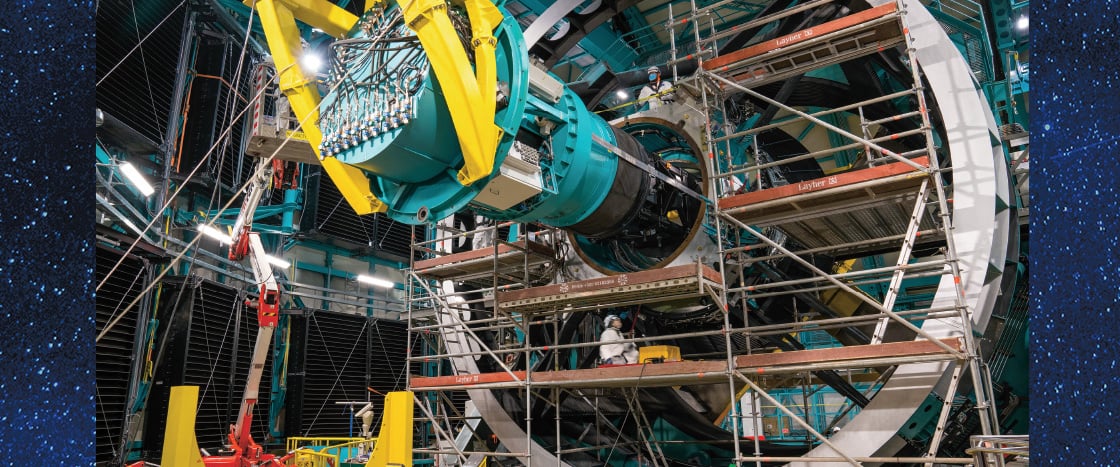
Shutterstock.com (Background); SLAC NATIONAL ACCELERATOR LABORATORY  (Telescope)

Workers carefully assembled the telescope over 10 years. The gigantic device has a 27.6-foot-wide mirror.

The observatory is taking nearly a thousand pictures every night. It will look for space rocks in our solar system to check whether any might pass close to Earth. It will track planets around faraway stars. And it will help scientists learn more about the matter that makes up our universe.

Activities (2)
Answer Key (1)
Text-to-Speech