

Article
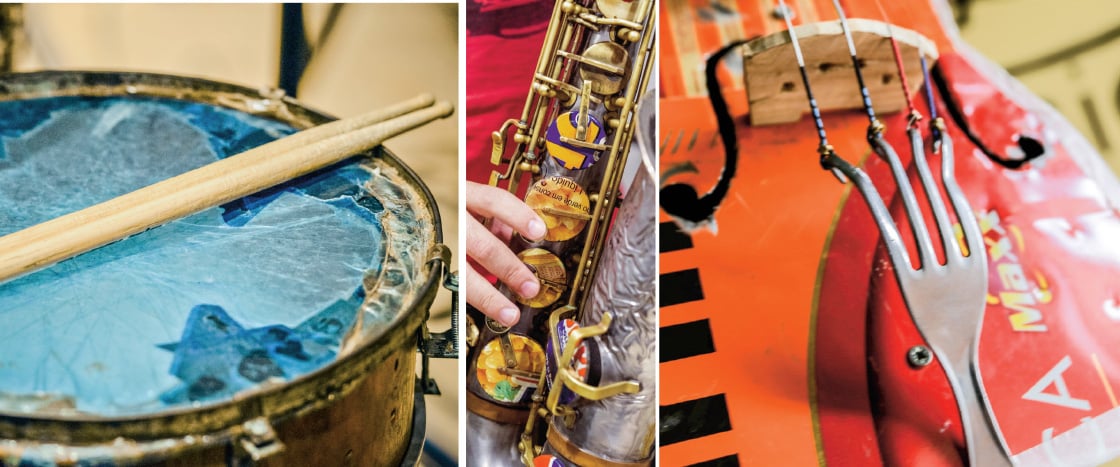
Courtesy of Landfill Harmonic Movie (Drum); Oscar Gonzalez/NurPhoto via Getty Images (Saxophone); JORGE ADORNO/Reuters (Violin)

From Trash to Tunes

A special orchestra and its unusual instruments leave a remarkable legacy.

By Ashley P. Taylor and Jess McKenna-Ratjen
From the May/June 2026 Issue

Learning Objective: Students will explain how and why a special orchestra makes instruments from trash.

Lexile: 870L; 630L
Other Focus Areas: Materials, Math

Standards

Download and Print
Meet the Recycled Orchestra!
Watch a video about an orchestra that uses unusual instruments.

Jorge Saenz/AP Images 

Ada Ríos played the violin while she was in the Recycled Orchestra.

When Ada Ríos was 11 years old, she got an invitation that any music student would love to get. She had been taking violin lessons and her skills were quickly growing. So in 2009, her music teacher asked her to join a community orchestra in her neighborhood of Cateura in the South American country of Paraguay.

But Ríos didn’t join an ordinary orchestra, and she wasn’t playing an ordinary violin. Her violin was made from a paint can! Her fellow students played instruments made from items like forks, bottle caps, and pipes. Engineer and musician Favio Chávez founded the group, called the Recycled Orchestra, using instruments made of trash from a local landfill.

The project, which is still active today, has brought the world of music to dozens of kids in Cateura. All thanks to engineering and teamwork!

Ada Ríos got an invitation when she was 11 years old. It was one any music student would love to get. She had been taking violin lessons. Her skills were quickly growing. So her music teacher asked her to join a community orchestra in 2009. It was in her neighborhood of Cateura. It’s in the South American country of Paraguay.

But Ríos didn’t join a regular orchestra. And she wasn’t playing a regular violin. Her violin was made from a paint can! Her fellow students played unusual instruments too. They were made from items like forks, bottle caps, and pipes. Engineer and musician Favio Chávez founded the group. It’s called the Recycled Orchestra. It uses instruments made of trash from a local landfill.

The project is still active today. It’s brought the world of music to dozens of kids in Cateura. All thanks to engineering and teamwork!

VALERIE MACON/AFP/Getty Images 

Favio Chávez (center) founded the Recycled Orchestra.

Dream Team

JIM MCMAHON/MAPMAN® 

Cateura is home to Paraguay’s largest landfill. It’s on the outskirts of the country’s capital, Asunción. Most of the city’s trash ends up there. Many people in Cateura support themselves and their families by gathering and selling recyclable materials from the landfill. Money for musical instruments and lessons is very difficult to come by.

Chávez wanted to use landfill materials to make instruments for local students. He teamed up with a carpenter named Nicolás Gómez to find a way.

First, Gómez studied and measured a professional violin. A violin is a string instrument with a hollow body that’s played with a bow. To make music, a musician must draw the bow over four metal strings. The vibration of the strings produces sound waves, which echo through the hollow body. The echo amplifies the sound, making it loud enough to be heard from a distance (see “Parts of a Violin”).

Next, Chávez and Gómez searched the landfill for materials that could be turned into instruments. Paint cans were hollow like the violin’s body. Could attaching a neck using a carved piece of wood turn a paint can into a violin?

“We tried to find items that can imitate classical instruments,” says Chávez.

Cateura is home to Paraguay’s largest landfill. It’s outside the country’s capital, Asunción. Most of the city’s trash ends up there. Many people in Cateura support themselves and their families from the landfill. They sift through the trash to gather and sell recyclable materials. Money for musical instruments and lessons is very hard to come by.

Chávez wanted to make instruments for local students. And he wanted to do it using landfill materials. He teamed up with a carpenter named Nicolás Gómez. Together, they found a way.

First, Gómez studied and measured a professional violin. A violin is a string instrument with a hollow body. A musician draws a bow over four metal strings to make music. The vibration of the strings produces sound waves. They echo through the instrument’s hollow body. The echo amplifies the sound. That makes it loud enough to be heard from a distance (see “Parts of a Violin”).

Next, Chávez and Gómez searched the landfill. They needed materials that could be turned into instruments. Paint cans were hollow like the violin’s body. Could attaching a neck using a carved piece of wood turn a paint can into a violin?

“We tried to find items that can imitate classical instruments,” says Chávez. 

Jorge Adorno/Reuters (Nicolás Gómez); CLAUDIA MORALES/Reuters (Bass)

Nicolás Gómez (left) turns an old metal drum into the body of an upright bass.

Breakthrough

After building and testing many prototypes, Gómez finally created a working violin. The team moved on to other instruments. Large oil cans became the bodies of cellos. They found they could build wind instruments, such as trumpets and saxophones, out of discarded plumbing pipes. They turned bottle caps into keys. Pieces of X-ray film topped drums.

In 2006, the Recycled Orchestra was born.

Gómez built and tested many prototypes. He finally created a working violin. The team moved on to other instruments. Large oil cans became the bodies of cellos. They found tossed plumbing pipes. These became wind instruments, like trumpets and saxophones. Bottle caps became keys. Pieces of X-ray film stretched across drums.

The Recycled Orchestra was born in 2006.

Elliott Franks/eyevine/Redux 

The Recycled Orchestra performs in London, England.

Rise to Fame

For the orchestra’s first couple of years, only local people knew about it. That’s when Ríos joined.

Then, in 2012, the orchestra performed at a conference in Argentina. A video of the group appeared online. After that, people all around the world began to pay attention to the orchestra. It was invited to play at events around the world. In 2015, Ríos and her paint can violin appeared in a documentary about the group.

Ríos left the orchestra in 2019, leaving behind her paint can violin for a new student to play. She plays music professionally today. But she’ll never forget her time in Cateura—or Chávez.

“Playing in the Recycled Orchestra helped me overcome shyness and fear,” she says. “It helped me find my path through music.”

For the first couple years, only local people knew about the orchestra. That’s when Ríos joined.

Then the orchestra performed at a meeting in Argentina in 2012. A video of the group appeared online. The orchestra drew worldwide attention after that. They were invited to play at events around the globe. Ríos and her paint can violin were in a movie about the group in 2015. 

Ríos left the orchestra in 2019. She left behind her paint can violin for a new student. She plays music professionally today. But she’ll never forget her time in Cateura or Chávez.

“Playing in the Recycled Orchestra helped me overcome shyness and fear,” she says. “It helped me find my path through music.”

video (1)
Slideshows (1)
Activities (12)
Quizzes (1)
Answer Key (1)
Text-to-Speech