

Article
Courtesy of Dr. Dennis Hong

I Design Robots

Dennis Hong creates some of the world’s most intelligent machines.

By Hailee Romain
From the May/June 2026 Issue

Learning Objective: Students will summarize how and why a robot designer builds humanoid robots.

Lexile: 860L; 620L

Standards

Download and Print
Robots at Work
Watch a video about robots in factories, homes, and schools.

Courtesy of Dr. Dennis Hong 

Dr. Dennis Hong 

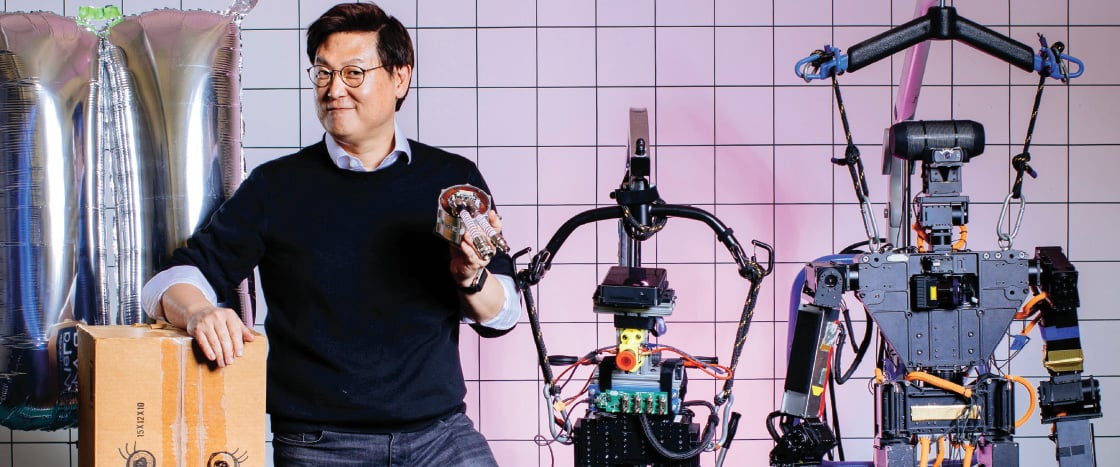
What if you had a robot to clean your room and take out the trash so you didn’t have to? Dennis Hong wants to make this possible!

Hong is an engineer at the University of California, Los Angeles, who builds robots. He runs the school’s Robotics and Mechanisms Laboratory. There his team develops amazing robots.

“Our goal is to make intelligent machines that do the work people can’t do or don’t want to do,” says Hong. Hong spoke with Scholastic about what it’s like to develop robots that tackle all sorts of tasks.

What if you had a robot to clean your room? Or one to take out the trash so you didn’t have to? Dennis Hong wants to make this possible!

Hong is an engineer. He works at the University of California, Los Angeles. He runs the school’s Robotics and Mechanisms Laboratory. There his team makes amazing robots.

“Our goal is to make intelligent machines that do the work people can’t do or don’t want to do,” says Hong. He spoke with Scholastic. He shared what it’s like to create robots that do all sorts of tasks.

How did you become interested in robotics?

Illustration by Katy Dockrill

My parents took me to see the original Star Wars movie when I was 7. I was captivated by the fictional robots in the movie. That’s when I knew I wanted to build real-life robots when I grew up.

My parents took me to see the original Star Wars movie when I was 7. I was amazed by the movie’s made-up robots. I knew what I wanted to do when I grew up. I wanted to build real-life robots.

What types of robots do you design?

My lab makes all kinds of robots. But we focus on creating humanoid, or human-shaped, ones. The trickiest part of developing this type of robot is perfecting its movements, like hand motions and walking.

Building robots that move like humans is important because many objects in our lives—from stairs to doors to dishwashers—have been designed to be used by people. For robots to be helpful, they must be able to interact with items like we do.

My lab makes all kinds of robots. But we focus on ones that are humanoid, or human shaped. The hardest part is creating these robots’ movements. For example, hand motions and walking.

Stairs, doors, dishwashers, and many other objects in our lives are made for people to use. That’s why building robots that move like humans is important. Robots must be able to interact with items like we do to be helpful.

Courtesy of Dr. Dennis Hong 

A speedy, soccer-playing robot called ARTEMIS can walk about 7 feet per second.

How does your team decide what to build?

We sometimes design robots for the government, to help with things like disaster and emergency relief, like firefighting. We also work with companies to develop robots to improve their business, like a cooking robot for a restaurant.

We participate in competitions too. Every year, we compete in the RoboCup, a soccer tournament where all the players are humanoid robots. They’re programmed to locate, aim, and kick soccer balls by themselves. Recently, we won with our new robot ARTEMIS—the world’s fastest-walking humanoid robot!

We sometimes create robots for the government. They can help with things like disaster and emergency relief, like firefighting. We also work with companies. We create robots to help their businesses. One example is a cooking robot for a restaurant.

We take part in contests too. We compete in the RoboCup every year. It’s a soccer tournament. But all the players are humanoid robots. They’re programmed to find, aim, and kick soccer balls by themselves. Recently, we won with our new robot ARTEMIS. It’s the world’s fastest-walking humanoid robot!

How do you make a new robot?

Our team is made up of people with different skills working together. We start by brainstorming to come up with ideas. Next we use a computer program. It allows us to see how a design might work before we build it. Then we program the robot’s software, or computer instructions. We make the metal parts and electronics after that. We test the robot once it’s finished to see what needs to be improved. 

We’re training for the trip in stages. First we learned about the basic parts of the spacecraft. Then we learned how to fly it. Now we’re using a simulator. It models what it will be like when we launch, land, and more. We also practice working while weightless. We dangle from harnesses attached to tall cranes. We’ll be floating most of the time in space.

Where do you find inspiration for your designs?

Illustration by Katy Dockrill

Many ideas come from observations I’ve made and written in my notebooks. One example is our robot STriDER, a tripod-shaped walking machine. It moves by swinging its rear leg forward and placing it ahead of the other two. I got the idea for this movement when I noticed the motion of a woman’s hands as she braided a child’s hair.

Many ideas come from observations I’ve made. I write them in my notebooks. One example is our robot STriDER. It’s a tripod-shaped walking machine. It moves by swinging its rear leg forward. Then it places it ahead of the other two. I got the idea for this motion when I noticed how a woman’s hands moved as she braided a child’s hair. 

What is your favorite robot you’ve created?

They’re all my favorites! Our projects, big or small, make the world a better place. Robots will only become more useful as technology improves.

They’re all my favorites! Our projects, big or small, make the world a better place. Robots will only become more useful as technology gets better.

video (1)
Activities (2)
Answer Key (1)
Text-to-Speech