
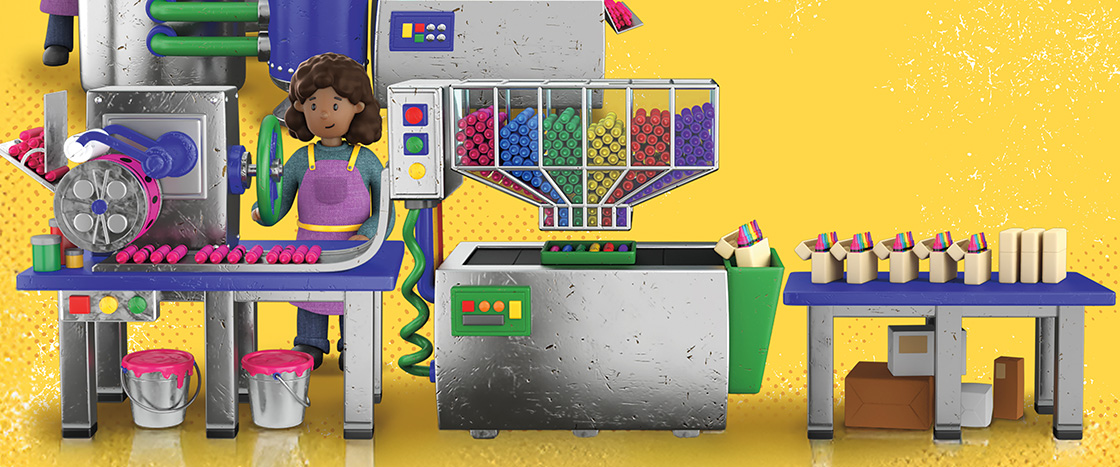

A girl operates a colorful marker factory assembly line with machines and finished markers on tables
Illustrated by Mora Vieytes

The Colorful Story of Crayons

How the crayons you use every day came to be.

By Natalie Smith
From the September 2026 Issue

Learning Objective: Students will describe how and why crayons have changed over time.

Lexile: 890L; 680L
Other Focus Areas: Engineering

Standards

Download and Print
Making Crayons!
Watch a video about how crayons are made.

Banana Mania, Jazzberry Jam, Mango Tango. These aren’t candy or ice cream flavors—they’re colors of Crayola crayons! Today the Crayola company makes 149 shades of crayons, from the originals (like red and blue) to the wonderfully wild.

That’s a good thing because kids use a lot of crayons. The average child in North America will go through about 730 crayons by age 10!

But crayons didn’t always work, or look, like they do today. Artists, scientists, and inventors have been testing different materials and production methods for centuries. With trial and error, crayons have improved over time. The result is colorful tools used by millions of young artists like you!

Banana Mania, Jazzberry Jam, Mango Tango. These aren’t candy or ice cream flavors. They’re colors of Crayola crayons! Today the Crayola company makes 149 crayon shades. That includes everything from red and blue to wilder colors. That’s a good thing because kids use a lot of crayons. The average child in North America will go through about 730 crayons. That’s just by age 10!

But crayons didn’t always work or look like they do today. Artists, scientists, and inventors have been testing different materials for centuries. They’ve also found new ways to make crayons. It took a lot of testing. But crayons have gotten better and better over time. The result is colorful tools used by millions of young artists like you!

Ancient Beginnings

People have been coloring their world for thousands of years. Ancient Greeks decorated their ships with a mixture of hot beeswax colored with pigments. (See “Crayons Through the Years”)

The tools for coloring continued to change. In the 1500s, Italian artist Leonardo da Vinci worked with pastels—oily chalks blended with pigment. In the 1790s, a French artist invented crayons made from charcoal and clay. But these tools were messy; they crumbled easily.

A breakthrough came when crayon makers switched from oil and chalk to wax. Unlike earlier materials, wax holds its shape.

By the late 1800s, American companies were selling wax crayons in small sets. Then two cousins took over their family’s pigment business and started making Crayola crayons in 1903. The first box had eight colors and cost a nickel.

For the first time, crayons gave kids an easy and affordable way to color. They quickly became kids’ go-to art supply.

“They’re an easy, quick, inexpensive tool that brings bright, smooth colors,” says Kelly Pacello. She manages scientists and engineers at Crayola.

People have been coloring their world for thousands of years. Ancient Greeks even decorated their ships. They used a mix of hot beeswax colored with pigments. (See “Crayons Through the Years.”) The tools for coloring kept changing. Italian artist Leonardo da Vinci worked with pastels in the 1500s. They were oily chalks blended with pigment. A French artist invented crayons in the 1790s. They were made from charcoal and clay. But these tools were messy. They crumbled easily.

Then a breakthrough came. Crayon makers switched from oil and chalk to wax. Wax holds its shape better. American companies were selling small sets of wax crayons by the late 1800s. Then two cousins took over their family’s pigment business. They started making Crayola crayons in 1903. The first box had eight colors. It cost just a nickel. Kids now had a great way to color. Crayons quickly became kids’ go-to art supply. “They’re an easy, quick, inexpensive tool that brings bright, smooth colors,” says Kelly Pacello. She manages scientists and engineers at Crayola.

Creating Color

Today crayons are made using science and engineering—and a lot of wax. At the Crayola factory in Easton, Pennsylvania, trucks deliver thousands of gallons of wax that gets heated and stored in giant silos. “When the wax reaches its melting point, it changes from a solid into a liquid,” says Pacello.

Workers mix pigments into the liquid wax to make the desired color. Then they pour the wax into crayon-shaped molds. Cooling water helps the wax harden back into a solid in less than seven minutes.

The process of melting wax and reshaping it is a physical change. “Nothing is changing chemically. The wax is still the wax,” Pacello says. “It’s still made of the same matter, only its physical form has changed.”

Finally, each crayon is wrapped in a paper label and packed into boxes.

Today crayons are made using science and engineering. There’s also a lot of wax. The Crayola factory is in Easton, Pennsylvania. There, trucks deliver thousands of gallons of wax. It gets heated and stored in giant containers called silos. “When the wax reaches its melting point, it changes from a solid into a liquid,” says Pacello.

Workers mix pigments into the liquid wax to make the right color. Then they pour the wax into crayon-shaped molds. Cold water helps the wax harden. The wax forms back into a solid in less than seven minutes. The process of melting and reshaping wax is a physical change. “Nothing is changing chemically,” says Pacello. “The wax is still the wax. It’s still made of the same matter, only its physical form has changed.” Each crayon is wrapped in a paper label. Then they’re packed into boxes.

Growing the Rainbow

Crayola has continued adding colors and making improvements. By 1958, boxes had grown to 64 shades and included a built-in sharpener! As crayon options expanded, they also began to better reflect the world around us.

Kids have helped drive that change. As a third-grader in 2019, Bellen Woodard noticed a problem: Crayon boxes didn’t have enough shades to represent all skin colors. So she started the More Than Peach Project, using her own money to donate crayons of many colors for skin tones to schools. The next year, Crayola introduced Colors of the World, a set to represent a range of skin tones.

Crayola added colors and made changes over time. Boxes grew to 64 shades by 1958. And they had a built-in sharpener! Crayon options also began to better reflect the world around us. Kids have helped drive that change. Bellen Woodard noticed a problem as a third-grader. She saw that crayon boxes didn’t have enough shades for all skin colors. So she started the More Than Peach Project. She used her own money to donate crayons to schools. They had many colors for different skin tones. Crayola introduced Colors of the World the next year. This set includes a range of skin tones.

Letizia Le Fur/Onoky/Getty Images 

A Crayola crayon doesn’t get touched by a human hand until it reaches the artist!

The Future of Crayons

Crayons have come a long way from colored beeswax. Pacello thinks some of the best innovations lie ahead.

“One day, maybe we’ll have a system where kids can create any color they want,” she says. With more than 120 years of science, engineering, and imagination behind crayons, that future might be closer than you think.

Crayons have come a long way from colored beeswax. Pacello thinks some of the best inventions still lie ahead. “One day, maybe we’ll have a system where kids can create any color they want,” she says. There are hundreds of years of science, engineering, and imagination behind crayons. So that future might be closer than you think.

How has the method of making crayons changed over time?

How has the method of making crayons changed over time?

video (1)
Slideshows (1)
Activities (13)
Quizzes (1)
Answer Key (1)
Text-to-Speech