

About 22,000 years ago, the Great Ice Age peaked in North America. During this time, thick glaciers covered much of the continent. Earth’s average temperature was some 11 degrees Fahrenheit (6 degrees Celsius) colder than it is today. Brrr! Prehistoric people used handmade tools to hunt and fish. They wore furs to keep warm. You will need to bundle up too!
Back to Teacher View
Student View
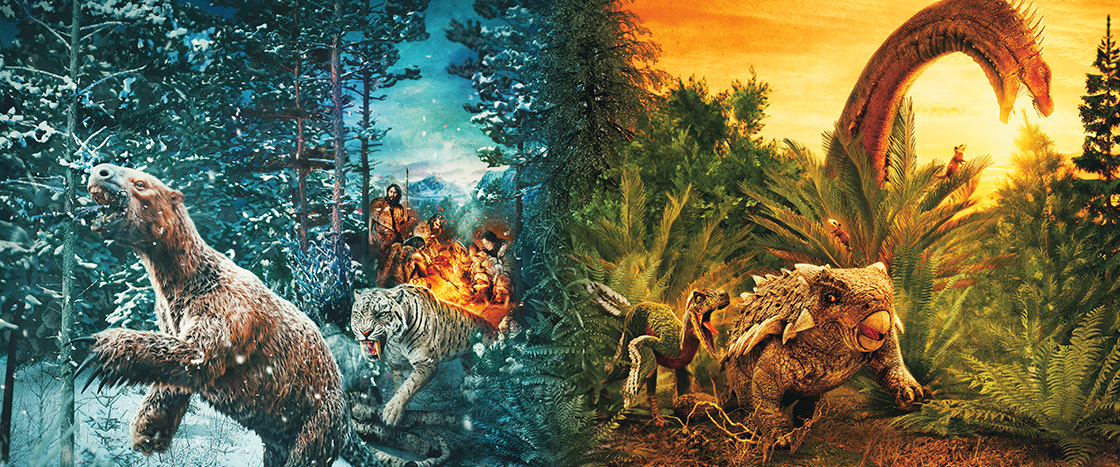
Illustrated by Randy Pollak
Would You Rather Visit the Ice Age or the Age of the Dinosaurs?
Read each section, then decide!
By Mara Grunbaum, Illustrated by Randy Pollak
From the September 2026 Issue
Learning Objective: Students will use information about two different time periods to support an argument.
Other Focus Areas: Evolution and Natural Selection
Standards

The Ice Age
Illustrated by Randy Pollak
The Destination
Gentle Giants
During the Ice Age, ancient animals greatly outnumbered people. Some of these now-extinct animals were jumbo-sized compared with their relatives living today. Giant ground sloths could stand more than 10 feet (3 meters) tall and weigh several tons. They didn’t climb trees like modern sloths do. They simply stood on their hind legs and ate leaves from treetops.
Potential Hazards
Be alert for fierce saber-toothed cats on the prowl. They used their strong front legs and knife-like teeth to hunt ground sloths, young mammoths, and possibly even humans. In what’s now Los Angeles, California, oil bubbled up from underground and formed sticky tar. Even large animals could fall into these tar pits and never escape. Watch your step—and your back!
The Age of the Dinosaurs
Illustrated by Randy Pollak
The Destination
Nearly 68 million years ago, North America was much warmer and wetter than it is today. Dinosaurs, like this titanosaur, were the largest animals on Earth. There were also small mammals, snakes, lizards, birds, and fish—but no people. Early humans wouldn’t exist for tens of millions of years.
Gentle Giants
Titanosaurs could grow to be more than 85 feet (26 meters) long and weigh as much as 11 elephants. Like most of the biggest dinosaurs, these massive animals ate only plants. Other humongous herbivores included the three-horned triceratops and armored ankylosaur. Some of the greens they munched on were among the world’s first flowering plants.
Potential Hazards
Massive, powerful predators like T. rex roamed North America during this time. But don’t underestimate the small, speedy Acheroraptor (ACK-ear-oh-rap-ter). This feathered meat eater was only about 3 feet (1 meter) tall but could take down animals many times its size. About 66 million years ago, a massive space rock smashed into Earth, wiping out most dinosaurs and other animals. If you visit this time, make sure you leave before it hits!
What does your class think?
Which time would you rather travel back to?
Which time would you rather travel back to?
Which time would you rather travel back to?
0%
0votes
{{result.answer}}
Total Votes: 0
Games
(1)
Activities
(2)
Skills Activities
Answer Key
(1)

Text-to-Speech