

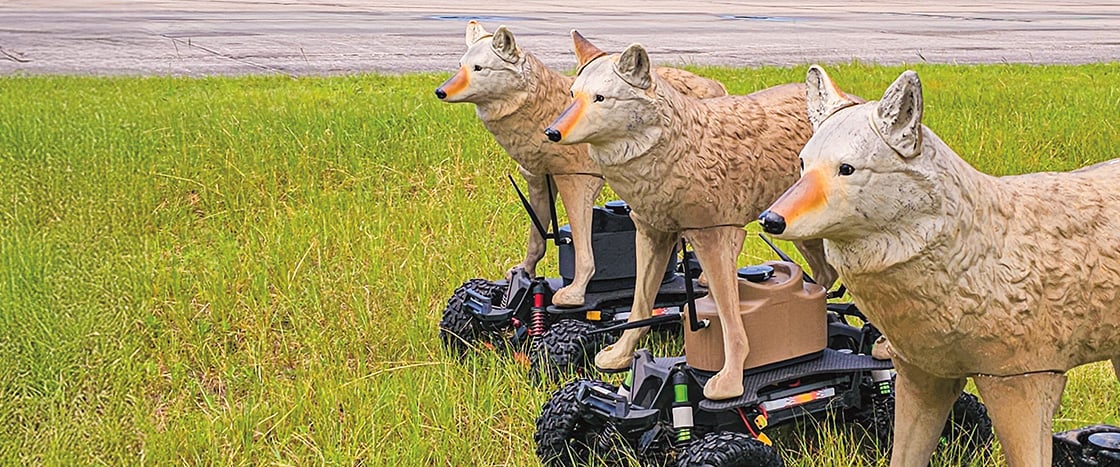

Three coyote models stand on remote-controlled wheeled robots in grass beside an airport runway
Engineer Research and Development Center/Army Corps of Engineers

Animal Bots on Call!

Robots that look like animals are being used to protect people, fight harmful invaders, spy on wildlife, and more!

By Corryn Wetzel and Jennifer Barone

Learning Objective: Students will explain how different animal-inspired robots help solve problems.

Lexile: 770L; 520L

Standards

Story Navigation

Download and Print
Robots at Work
Watch a video about the roles that robots play in our society.

Coyote Bots

Engineer Research and Development Center/Army Corps of Engineers

These coyote bots scare wildlife away from airfields. 

Sometimes birds collide with airplanes. When that happens, people, animals, and equipment can be harmed. So the U.S. Army Corps of Engineers is exploring a new way to keep birds away from runways. To scare away birds such as starlings and geese, they’re trying life-sized plastic coyotes.

The fake canines are mounted on robotic bases with wheels. People nearby control them. “In the past, we’ve trained real dogs to do this,” says Shea Hammond, who works on the robots. But robots are more reliable and easier to control. They also eliminate the risk of injuries to the dogs. 

The engineers plan to continue testing the coyote bots to see how well they keep the birds away. Their first tests at military airfields successfully scared away many birds! 

Sometimes airplanes hit birds. When that happens, people, animals, and airplanes can be harmed. So the U.S. Army is finding a new way to keep birds away from runways. They’re trying life-sized plastic coyotes to scare away birds.

The fake dogs are on robotic bases with wheels. People nearby control them. “In the past, we’ve trained real dogs to do this,” says Shea Hammond, who works on the robots. But robots are easier to control. They also take away the risk that real dogs could get hurt. 

The Army engineers plan to keep testing the coyote bots to see how well they keep the birds away. Their first tests at military airfields seemed to work. They scared away many birds!

dpa picture alliance/Alamy Stock Photo

Shooing birds away from runways helps keep planes and birds safe.

Bunny Bots

Robert McCleery

A rabbit robot in Florida

Shutterstock.com (Snake); Robert McCleery (Thermal)

A special thermal image shows heat the rabbit robots give off to attract pythons.

In the wetlands of South Florida, massive slithery invaders are on the loose! They’re Burmese pythons, snakes native to Southeast Asia. They have spread quickly, throwing the ecosystem out of balance. These invasive reptiles eat up native animals, which don’t have defenses against these snakes. Scientists have been trying all kinds of tricks to stop the snakes. This might be their cutest idea yet—fuzzy bunny bots! 

Scientists turned 40 cuddly rabbit stuffies into high-tech snake bait. They replaced the stuffing with motors and electronic components. The bots copy the movements of marsh rabbits, a favorite python meal. The scientists put the bots in cages and use cameras to see if they attract the snakes. 

If the bots work, they’ll be a safer and easier way to trap and remove these reptiles.

In the wetlands of South Florida, snakes are on the loose! Burmese pythons are snakes from Southeast Asia. But they have spread quickly in Florida. That has thrown the ecosystem out of balance. 

These invasive reptiles eat up native animals. These animals don’t have defenses against these snakes. Scientists have been trying all kinds of tricks to stop the snakes. This might be their cutest idea yet—fuzzy bunny bots! 

Scientists turned 40 cuddly rabbit stuffies into high-tech snake bait. They replaced the stuffing with motors and electronic parts. The bots copy the movements of marsh rabbits, a favorite python meal. The scientists put the bots in cages and used cameras to see if the snakes tried to eat them.

If the bots work, they’ll be a safer and easier way to trap these snakes.

Antelope Bots

Xinhua/Shutterstock

This fake antelope moves alongside a herd to monitor the endangered species. 

XI ZHINONG/NaturePL.com

A real chiru, or Tibetan antelope

Robots that look like animals are a great way for scientists to spy on wildlife—especially for shy creatures, like a type of antelope called a chiru. Chirus live in high-altitude areas of Central Asia. People used to hunt them. Now, they’re protected.

Scientists want to monitor wild chirus. But if people get too close, they run away. So scientists designed a chiru bot! It blends in with the herds while a scientist controls it from far away. 

Cameras inside the robot take pictures, helping scientists count the animals. The fake chiru also has wheels built into its feet so it can keep up with the herd. Shhh—don’t tell the real chirus! 

Robots that look like animals can help scientists spy on wildlife. That’s especially true for shy creatures, like a type of antelope called a chiru. Chirus live in high mountains in Central Asia. People used to hunt them. Now, they’re protected. 

Scientists want to monitor wild chirus. But if people get too close, they run away. So scientists designed a chiru bot! It blends in with the herds while a scientist controls it from far away. 

Cameras inside the robot take pictures, helping scientists count the animals. The fake chiru also has wheels built into its feet so it can keep up with the herd. Shhh—don’t tell the real chirus!

Bug Bots

Kevin Chen, Harvard Microbiotics Laboratory 

This bee-sized bot weighs as much as a paper clip!

Kees Smans/Getty Images 

Imagine a flying robot the size of a bee—but it won’t bite or sting you. This little robot might look like a bug, but it’s actually a drone. 

A mini drone designed by the Massachusetts Institute of Technology can flap its wings hundreds of times per second, like bees and flies. It can even handle being bonked! “You can hit it when it’s flying, and it can recover,” says Kevin Chen, one of the engineers. 

Chen hopes that one day the drones will be used as pollinators. Like bees, the drones could move pollen from one plant to another. 

Imagine a flying robot the size of a bee—but it won’t bite or sting you. This little robot might look like a bug, but it’s actually a drone. 

This mini drone was designed by the Massachusetts Institute of Technology. It can flap its wings hundreds of times per second, like bees and flies. It can even handle being bonked! “You can hit it when it’s flying, and it can recover,” says Kevin Chen, one of the engineers. 

Chen hopes that one day the drones will be used as pollinators. Like bees, the drones could move pollen from one plant to another.

He Built a Turtle Bot! 

Sixteen-year-old Evan Budz’s award-winning robot can spot underwater problems. 

Courtesy of family 

Evan Budz

High school student Evan Budz always wanted to help the environment, but he didn’t know how. Then, on a family camping trip, he spotted a snapping turtle swimming through the water. The turtle moved gently, without bothering anything around it. Evan wondered if he could create a robot that could do the same thing. 

“My creativity was immediately sparked, and BURT [short for Bionic Underwater Robotic Turtle] was born,” says Evan.

To make BURT as lifelike as possible, Evan spoke with experts at his local aquarium about sea turtles. He 3-D printed the robot’s parts: a round dome for the head, a wide tube for the body, and four flippers for swimming. 

High school student Evan Budz always wanted to help the planet, but he didn’t know how. Then, on a family camping trip, he spotted a snapping turtle swimming through the water. The turtle moved gently, without bothering anything around it. Evan wondered if he could create a robot that could do the same thing. 

“My creativity was immediately sparked, and BURT [short for Bionic Underwater Robotic Turtle] was born,” says Evan. 

To make BURT look as real as possible, Evan spoke with experts at an aquarium about sea turtles. Then he 3-D printed the robot’s parts. That included a round dome for the head and a wide tube for the body. It also has four flippers for swimming.

Courtesy of family

Evan tests and programs his bot.

Evan put a super-small computer and camera inside BURT to record everything the robot detects. He programmed the computer to flag problems like plastic trash or damaged coral.

Evan first tested BURT in his grandparents’ backyard pool using a fake coral reef to check its danger-spotting skills. Once that worked, Evan moved on to testing it in lakes. “That has been the most fun part so far,” he says.

Evan’s invention has already won some big awards, but for him, the work continues. He’s planning to test BURT in even deeper waters.

Evan put a super-small computer and camera inside BURT. That lets him record everything the robot finds. He programmed the computer to flag problems like plastic trash or damaged coral. 

Evan first tested BURT in his grandparents’ backyard pool. He used a fake coral reef to check if it could spot danger. Once that worked, Evan moved on to testing it in lakes. “That has been the most fun part so far,” he says. 

Evan’s invention has already won some big awards. But for him, the work continues. He’s planning to test BURT in even deeper waters.

Choose one of the bots in the article and describe one reason it was designed to look like a real animal.

Choose one of the bots in the article and describe one reason it was designed to look like a real animal.

video (1)
Slideshows (1)
Activities (13)
Quizzes (1)
Answer Key (1)
Text-to-Speech