

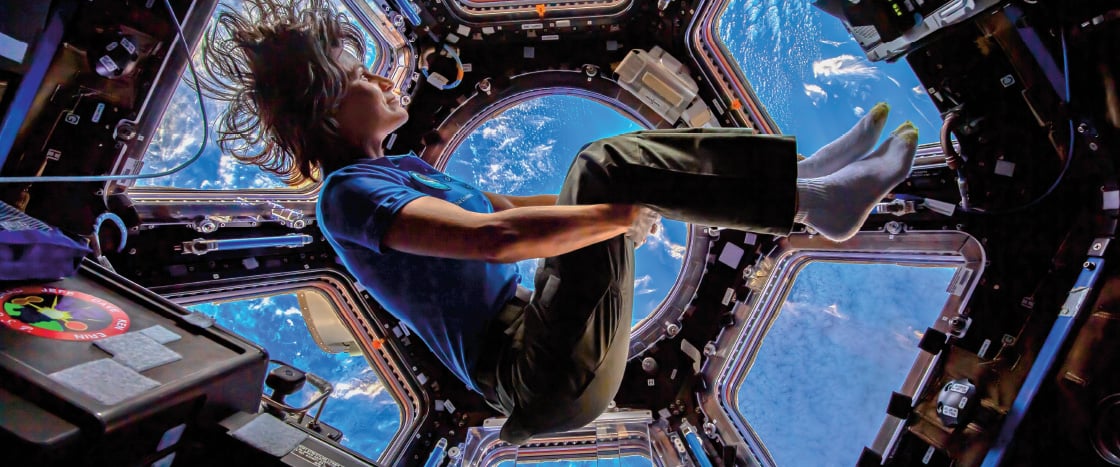

An astronaut floats with her knees drawn up in a domed module whose windows look down on Earth
ESA/NASA-S.Cristoforetti/ R. Rossi

Extreme Science Labs

Learn about Earth’s fastest, coldest, hottest, and highest science labs.

By Hailee Romain

Learning Objective: Students will compare and contrast four unique science labs.

Lexile: 980L; 710L

Standards

Download and Print
A Home in Space
Watch a video about what it's like to live and work at the International Space Station.

Fastest: International Space Station

The International Space Station zips around Earth at 17,500 miles (28,000 kilometers) per hour. Also known as the ISS, it travels so fast that it circles the planet every 90 minutes. Inside the station’s laboratories, astronauts perform experiments that aren’t possible anywhere on Earth.

That’s because everything aboard the station, including the astronauts, experiences microgravity. Without gravity’s downward pull, liquids, cells, and other parts of living things behave differently. Scientists on the ISS study how human bodies change in space. 

The International Space Station zips around Earth. It travels 17,500 miles (28,000 kilometers) per hour. It’s also called the ISS. It goes so fast that it circles the planet every 90 minutes. Inside the station, astronauts do experiments that can’t be done on Earth. 

That’s because everything aboard the station experiences microgravity. That includes the astronauts too! Without gravity pulling them down, liquids and cells act differently. Scientists on the ISS study how human bodies change in space. 

They also observe how microgravity affects plants grown for food. This research could help future astronauts stay healthy and nourished during long missions to the moon and Mars.

But scientists on the ISS don’t just study life in space. Instruments and cameras on the outside of the station track events on Earth, such as hurricanes, wildfires, and volcanic eruptions. These observations help scientists monitor Earth’s changing landscape. 

“The space station allows us to look at our planet with a new perspective,” says Sandra Jones, who works at NASA.

They also study how microgravity affects plants grown for food. This research could help future astronauts stay fed during long trips to the moon and Mars. 

But scientists on the ISS don’t just study life in space. Tools and cameras on the outside of the station track events on Earth. That includes hurricanes, wildfires, and volcanic eruptions. This helps scientists check how Earth’s landscape is changing. 

“The space station allows us to look at our planet with a new perspective,” says Sandra Jones, who works at NASA.

Highest: Pyramid Laboratory

Marc Bruxelle/Alamy Stock Photo 

The Pyramid laboratory is 16,568 feet above sea level.

Jim McMahon/Mapman® 

A glittering glass building known as the Pyramid sits on the slopes of Mount Everest in Nepal. To work at this remote research station, scientists must trek for several days, climbing over steep cliffs and icy paths with heavy packs full of supplies. 

At 16,568 feet (5,050 meters) above sea level, the Pyramid is an excellent place to study high-altitude environments. At this elevation, the air is thinner, temperatures are colder, and the atmosphere is less affected by pollution. This allows scientists to collect very accurate data on air pressure and gases in Earth’s atmosphere. 

Scientists have been collecting data at the Pyramid for 36 years. Comparing today’s measurements with older ones can reveal changes in the environment over time. 

A glittering glass building sits on the slopes of Mount Everest in Nepal. It’s called the Pyramid. Scientists must hike for days to get there. They have to climb over steep cliffs and icy paths. They carry heavy packs full of supplies. 

The Pyramid is a great place to study high-altitude environments. It is 16,568 feet (5,050 meters) above sea level. Up that high, the air is thinner and temperatures are colder. Also, the air is less affected by pollution. This lets scientists study the air and gases around Earth.  

Scientists have been collecting data at the Pyramid for 36 years. They compare new measurements with old ones. This shows how the environment has changed over time.

Hottest: Hawaiian Volcano Observatory

Jim Sugar/Getty Images

The lava in Kilauea’s caldera is a scorching 2,000°F.

Jim McMahon/Mapman® 

Kilauea (kee-lah-WAY-ah), one of the world’s most active volcanoes, erupts as often as every 10 to 11 days! For more than 100 years, the Hawaiian Volcano Observatory (HVO) stood on the edge of the volcano’s caldera. But in 2018, volcanic earthquakes during an eruption damaged the building beyond repair. 

A new HVO headquarters is under construction and set to open in 2027. In April 2026, a field station was built on Kilauea so scientists can keep watch on the volcano. Instruments track its activity 24 hours a day. Small earthquakes or changes in volcanic gases mean an eruption may happen soon. Scientists can issue warnings as needed. 

Because Kilauea erupts so often, scientists observe as the volcano changes Earth’s surface in real time. 

Kilauea (kee-lah-WAY-ah) is one of the world’s most active volcanoes. It erupts as often as every 10 to 11 days! 

Scientists study Kilauea at the Hawaiian Volcano Observatory (HVO). For more than 100 years, it stood on the edge of the volcano’s caldera. But in 2018, the volcano erupted. It damaged the building badly. 

A new HVO building is under construction. It is set to open in 2027. In April 2026, scientists built a field station on Kilauea. Now they can keep watch on the volcano. Tools track its activity 24 hours a day. Small earthquakes or changes in volcanic gases mean an eruption may happen soon. Scientists can issue warnings as needed. 

Kilauea erupts so often that scientists can watch it change Earth’s surface in real time.

Courtesy rendering/USGS 

A drawing of the new observatory headquarters in Hawaii

Coldest: South Pole Telescope

Courtesy of Keith Vanderlinde

The average winter temperature at the South Pole is -76°F.

Jim McMahon/Mapman® 

Antarctica is the coldest, driest place on Earth—which makes it perfect for looking at space through a telescope. These conditions create clear air with little moisture to block or blur light from the stars. This allows the South Pole Telescope to detect light and energy that’s been traveling for nearly 

14 billion years—since right after the universe formed! It can also collect data about objects too faint for many other telescopes to see.

Paul Chichura is an astronomer. He uses the South Pole Telescope’s sensitive cameras to detect weak energy signals, like radio waves, traveling through the vast reaches of space. These signals are left over from the earliest days of the universe. Scientists study the signals to learn what the universe was like when it was very young. It’s “like looking at a baby picture,” says Chichura. 

Antarctica is the coldest, driest place on Earth. That makes it perfect for looking at space through a telescope. The air there is clear and dry. There is little moisture to block or blur light from the stars. 

This helps the South Pole Telescope find light that’s been traveling for nearly 14 billion years. That’s light from right after the universe formed! It can also spot things too dim for other telescopes to see. 

Paul Chichura is an astronomer. He uses the South Pole Telescope’s sensitive cameras to find weak energy signals in space, like radio waves. These signals are left over from the earliest days of the universe. The signals show what the universe was like when it was very young. It’s “like looking at a baby picture,” says Chichura.

Compare and contrast two of the labs. Which one would you rather work at? Why? 

Compare and contrast two of the labs. Which one would you rather work at? Why? 

video (1)
Slideshows (1)
Activities (14)
Quizzes (1)
Answer Key (1)
Text-to-Speech