
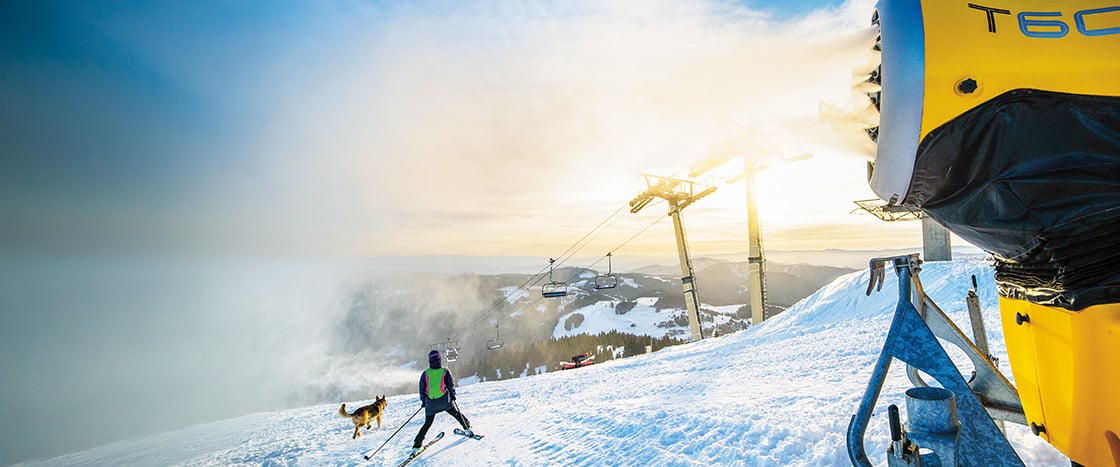

A skier in a green vest glides down the slope beside a dog as a yellow snow cannon sprays mist
Shutterstock.com

The Fake Snow Fix

When snow is scarce, ski resorts have a solution.

By Isobel Whitcomb and Jacqueline Adams

Learning Objective: Students will explain why artificial snow is used and compare its properties with those of natural snow.

Lexile: 790L; 620L

Standards

Download and Print
States of Matter
Learn all about the states of matter.

Whoosh! Skiers and snowboarders race down a snowy slope. What makes this classic winter sight noteworthy? This snow didn’t fall from clouds in the sky—machines made it! 

Hours earlier, white mist blasted from a giant, roaring machine on the ski slope. The mist sparkled like clouds of glitter as frozen water droplets fell to the ground. Find out why making fake snow is becoming more popular—and even essential—for some winter sports. 

Whoosh! Skiers and snowboarders race down a snowy slope. What makes this classic winter sight such a big deal? This snow didn’t fall from clouds in the sky. Machines made it! 

Hours earlier, white mist blasted from a giant machine on the ski slope. The mist sparkled like clouds of glitter. Tiny frozen water droplets fell to the ground. 

Find out why more places are making fake snow. For some winter sports, it’s a must! 

A No-Snow Problem

Picture this: You’ve spent months waiting for your chance to feel the thrill of zooming down a ski slope. You have your gear, your helmet, and your lift pass. But if there’s no snow, you’re out of luck! Ski resorts can’t always count on snowy weather. In some places, snowfall varies a lot. And for many areas, the chances of snowfall have decreased. That’s because climate change is causing Earth’s average temperature to rise. 

A lack of snow affects more than just skiers and snowboarders. It also impacts people who live and work near resorts. Often their jobs depend on tourism. No snow means no visitors—which means no business. 

When snow is in short supply, snowmaking machines offer a solution. If it’s cold enough outside, artificial snow allows skiing and snowboarding to go on.

Picture this: You’ve waited months to zoom down a ski slope. You have your gear, your helmet, and your lift pass. But if there’s no snow, you’re out of luck! Ski resorts can’t always count on snowy weather. Some places get lots of snow one year, and very little the next year. And for many areas, the chances of snowfall have gone down. That’s because climate change is making Earth’s average temperature higher.  

Less snow doesn’t just affect skiers and snowboarders. It also affects people who live and work nearby. Their jobs often depend on tourism. No snow means no visitors—which means no business. 

When there isn’t enough snow, snowmaking machines can help. If it’s cold enough outside, they can make snow for skiing and snowboarding. 

Winter Wonderland

Shutterstock.com 

Skiers call natural snow “fresh powder.” It feels light and fluffy. 

Making snow isn’t as easy as spraying a hose at a chilly mountainside. A typical snowmaking machine weighs as much as a small car. It looks like a jet engine on a stand. The machine sprays droplets of water into the cold air. (See How Artificial Snow Is Made.) The droplets freeze before they hit the ground. This artificial snow is made of tiny balls of ice. Snow builds up in layers until it’s thick enough for skiing and snowboarding. 

Unlike fake snow, natural snow forms high in the clouds and falls as delicate crystals. (See Natural vs Artificial.) Skiers and snowboarders can notice the difference in texture. 

“Natural snow feels fluffy and soft,” says weather scientist Peter Veals. “With artificial snow, you feel every bump.”

Making snow isn’t as easy as spraying a hose at a chilly mountainside. A typical snowmaking machine weighs as much as a small car. It looks like a jet engine on a stand. The machine sprays droplets of water into the cold air. (See How Artificial Snow is Made.) The droplets freeze before they hit the ground. This artificial snow is made of tiny balls of ice. Snow builds up in layers until it’s thick enough for skiing and snowboarding. 

Natural snow is different. It forms high in the clouds. Then it falls as light crystals that can break easily. (See Natural vs. Artificial.) Skiers and snowboarders can feel the difference.

“Natural snow feels fluffy and soft,” says weather scientist Peter Veals. “With artificial snow, you feel every bump.” 

Fluffy or Fast?

Which snow is better for winter sports? It depends. “Natural snow feels amazing to ski through,” Veals says. But surprisingly, many professional athletes prefer artificial snow. Its smooth, icy texture creates less friction when skis or snowboards rub against it. This helps racers slide even faster toward the finish line. 

The downside? That slicker surface makes it harder for them to slow down and stay in control. 

Depending on the weather conditions, natural snow might be fluffy, firm, or slushy. Artificial snow is typically firm, so athletes know what to expect. But in the event of a fall, landing on that harder surface increases the risk of injury. For these reasons, artificial snow can be trickier for beginner skiers and snowboarders. 

Which snow is better for winter sports? It depends. “Natural snow feels amazing to ski through,” Veals says. But surprisingly, many top athletes prefer artificial snow. Artificial snow is smooth and icy. Skis and snowboards slide over it with less friction. This helps racers go even faster toward the finish line. 

The downside? That slicker snow makes it harder to slow down and stay in control. 

Natural snow might be fluffy, firm, or slushy. It depends on the weather. Artificial snow is usually firm, so athletes know what to expect. But if they fall, they’re more likely to get hurt on the harder snow. That’s why artificial snow can be trickier for beginners.  

Shutterstock.com 

This slope in Europe would have been completely bare without snow machines.

An Imperfect Solution

As long as temperatures are below freezing, snowmaking can help keep slopes covered when natural snow is scarce. But it comes with a cost. Large amounts of water must be pumped uphill to the machines. The water comes from rivers and streams. That’s a concern, especially in dry regions where fresh water is already limited. 

“The majority of the water used to create artificial snow eventually melts back into the streams it was pumped from,” says Veals. However, about 10 to 40 percent evaporates into the air.

Snowmaking also consumes large amounts of energy. Electricity powers the machines and the pumps that move water. If the electricity comes from power plants that burn fossil fuels, it can contribute to climate change—the very factor that’s reducing snowfall in the first place! 

As winters change, ski resorts face a tricky question: How can enough snow be made for people to enjoy the slopes while conserving limited resources? The future of winter sports might depend on the answer. 

Snowmaking can keep the slopes covered when there isn’t much natural snow. But it only works when the weather is below freezing. And it comes with a cost. Lots of water must be pumped uphill to the machines. The water comes from rivers and streams. That’s a problem in dry places. They don’t have much fresh water to spare. 

Most of the water melts back into the streams it came from, says Veals. But about 10 to 40 percent evaporates into the air. 

Snowmaking uses lots of energy. Electricity powers the machines and the pumps that move water. Some power plants burn fossil fuels to make electricity. That adds to climate change. And climate change is the reason there’s less snow in the first place! 

As winters change, ski resorts face a tricky question. How can they make enough snow for skiers and snowboarders without using too much water or energy? The future of winter sports might depend on the answer.

Explain two benefits and two drawbacks of artificial snow.

Explain two benefits and two drawbacks of artificial snow.

video (1)
Slideshows (1)
Activities (5)
Quizzes (1)
Answer Key (1)
Text-to-Speech